1. Introduction to Partnership
As a sole proprietor’s business grows, the need for more capital, additional skills, and shared responsibility arises. A single owner often finds it difficult to manage everything alone. To overcome these limitations, two or more persons join hands to run a business together — this form of business organisation is called a Partnership.
Definition (Indian Partnership Act, 1932 – Section 4)
“Partnership is the relation between persons who have agreed to share the profits of a business carried on by all or any of them acting for all.”
Features of Partnership
- Two or more persons (Min. 2; Max. 50 as per Companies Act, 2013).
- Agreement (oral or written) between partners.
- Lawful business carried on for profit.
- Sharing of profits and losses in an agreed ratio.
- Mutual agency — every partner is both an agent and a principal.
- Unlimited liability of partners (jointly and severally).
2. Partnership Deed
A Partnership Deed is a written document containing the terms and conditions of partnership, signed by all partners. It helps avoid future disputes.
Contents of a Partnership Deed
- Name and address of the firm and partners
- Nature of business and duration
- Capital contributed by each partner
- Profit/Loss sharing ratio
- Interest on Capital, Drawings, and Loan
- Salary, commission or remuneration to partners
- Rights, duties and powers of partners
- Method of admission, retirement and dissolution
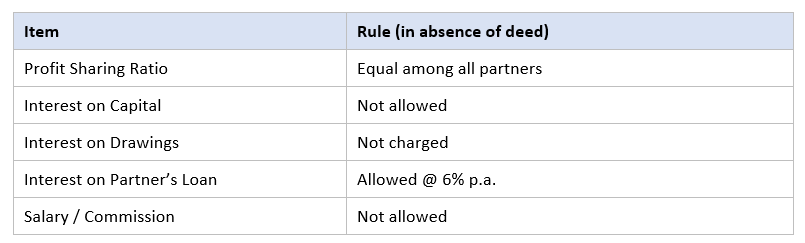
3. Provisions in the Absence of a Partnership Deed
If there is no deed, or the deed is silent on a particular matter, the following rules of the Indian Partnership Act, 1932 apply:
4. Key Terms in Partnership Accounts
Capital Account: The account showing the amount contributed by each partner. It can be maintained under the Fixed Capital Method (Capital A/c + Current A/c) or the Fluctuating Capital Method (only one Capital A/c).
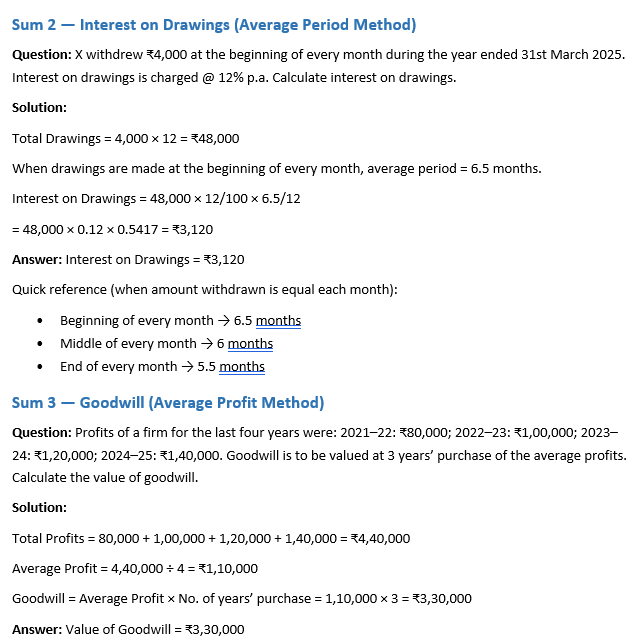
Drawings: Amount or goods withdrawn by a partner from the firm for personal use.
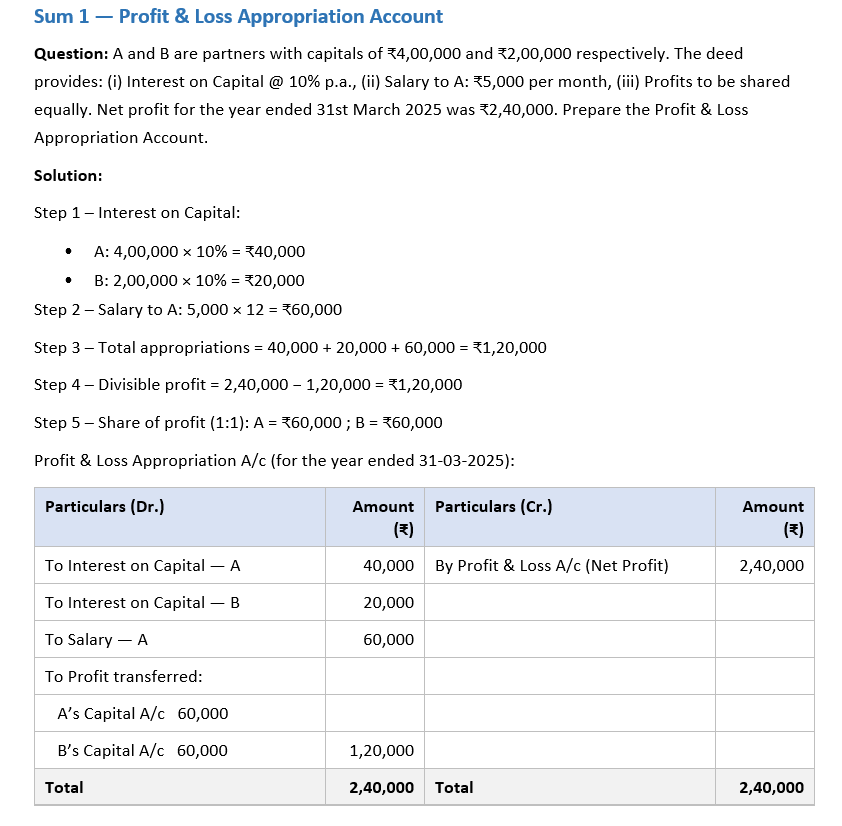
Interest on Capital: Return allowed to a partner on the capital invested. It is an appropriation of profit, not a charge.
Interest on Drawings: Interest charged by the firm from a partner on the amount withdrawn for personal use.
Partner’s Salary / Commission: Remuneration given to active partners as per the deed. Treated as an appropriation of profit.
Profit & Loss Appropriation Account: An extension of the P&L Account showing how net profit is distributed among partners (interest on capital, salary, commission, share of profit, etc.).
Goodwill: The monetary value of a firm’s reputation. It is paid by an incoming partner for the right to share future profits.
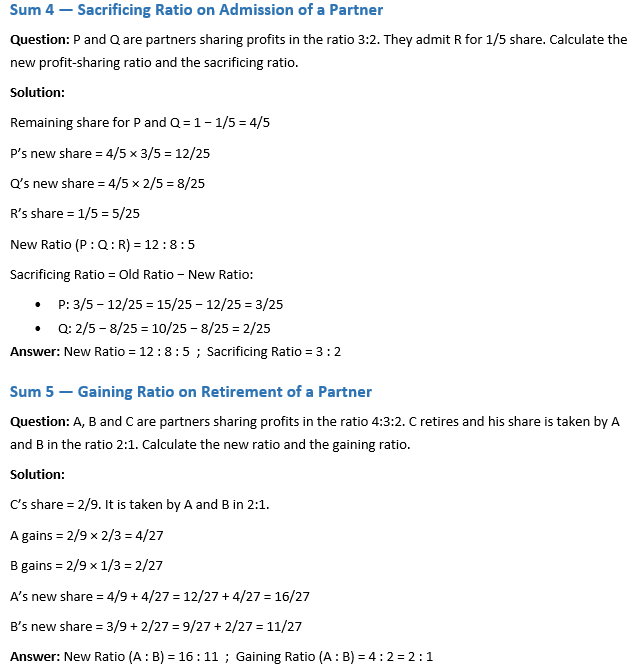
Sacrificing Ratio: The ratio in which old partners surrender their share of profit in favour of a new partner. Sacrificing Ratio = Old Ratio − New Ratio.
Gaining Ratio: The ratio in which the continuing partners gain the share of a retiring/deceased partner. Gaining Ratio = New Ratio − Old Ratio.
5. Worked Sums
The following solved problems will help you understand how the above concepts are applied in practice.
6. Quick Revision Points
- Partnership = relation between persons sharing profits of a business carried on by all or any of them acting for all.
- Maximum number of partners = 50.
- In absence of deed: equal profits, no IOC, no salary, IOL @ 6% p.a.
- Interest on Capital and Salary are appropriations, not charges.
- Sacrificing Ratio = Old − New; Gaining Ratio = New − Old.
- Goodwill (Average Profit Method) = Average Profit × No. of years purchase.

Swathika B is an MBA graduate in Finance & Business Analytics , the founder of The Commerce Lab. With a strong academic foundation in B.Com BFSI and hands-on experience in financial analysis, data analytics, and business studies, she created this platform to make Commerce and Accountancy simple, practical, and exam-ready for students across India.