Introduction
Every government needs money to run the country — to build roads, schools, hospitals, pay police, run defence and much more. This money comes from taxes collected from citizens and businesses.
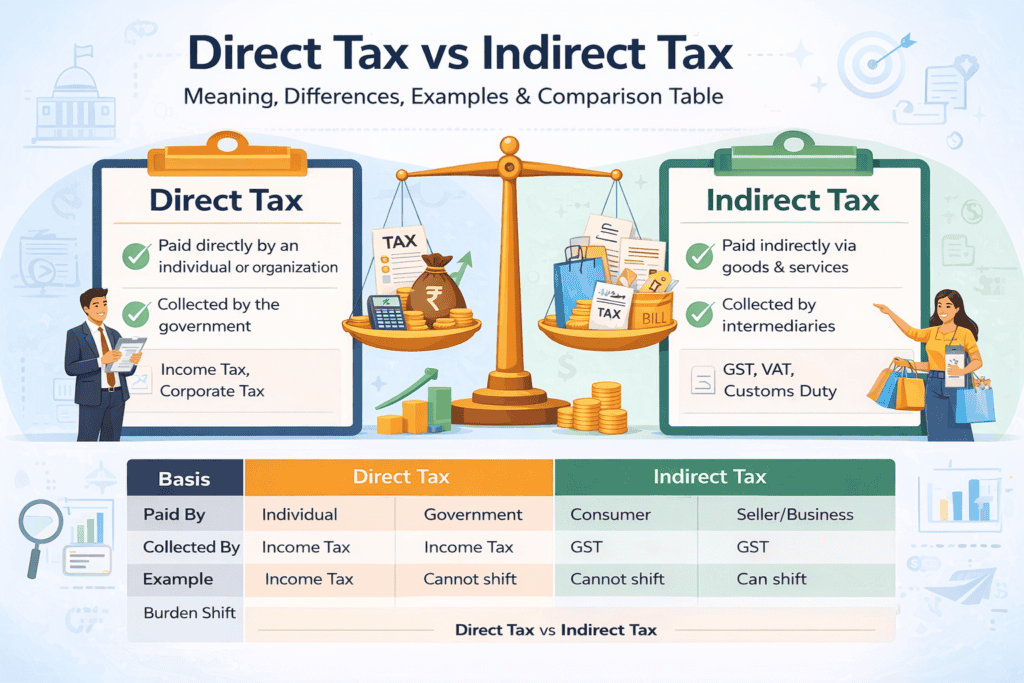
Taxes in India are mainly of two types:
- Direct Tax — where you pay the tax yourself directly to the government
- Indirect Tax — where you pay the tax indirectly while buying something
Simple rule: If YOU pay the tax from YOUR own pocket to the government — it is Direct Tax. If you pay tax as part of a product’s price through a seller — it is Indirect Tax.
Real Life Examples Before We Start
Direct Tax Example: Ramesh earns Rs. 10 lakhs per year. The government says — pay 20% income tax. Ramesh pays Rs. 2 lakhs directly to the government. Nobody else pays this for him.
Indirect Tax Example: Sunita buys a new smartphone worth Rs. 20,000. The shopkeeper charges 18% GST = Rs. 3,600 extra. Sunita pays Rs. 23,600 total. The shopkeeper deposits the Rs. 3,600 GST with the government. Sunita paid the tax — but indirectly through the shopkeeper.
24 Differences Between Direct Tax and Indirect Tax
| Point of Difference | Direct Tax | Indirect Tax |
| 1. Meaning | A tax paid directly by a person or company to the government from their own income or profit. | A tax collected by a middleman (seller/manufacturer) from the buyer and then paid to the government. |
| 2. Who Pays? | The person on whom the tax is imposed pays it himself — e.g., salaried employee paying Income Tax. | The final consumer (buyer) pays it indirectly while purchasing goods or services — e.g., GST on a phone. |
| 3. Can the Tax Be Shifted? | NO. The taxpayer cannot pass the burden to anyone else. You earn it, you pay it. | YES. The seller passes the tax burden to the buyer by including it in the price of the product. |
| 4. Nature (Progressive vs Regressive) | Progressive — the more you earn, the more tax you pay. Rich people pay more than poor people. | Regressive — everyone pays the same tax rate regardless of income. A poor person and a rich person pay the same GST on a biscuit. |
| 5. Common Examples | Income Tax, Corporate Tax, Capital Gains Tax, Securities Transaction Tax (STT). | GST, Customs Duty, Excise Duty, Entertainment Tax, Service Tax (old). |
| 6. When is it Paid? | Paid at the end of the financial year (or quarterly as advance tax) based on income earned. | Paid immediately at the time of buying a product or service — included in the bill. |
| 7. Who Collects It? | The taxpayer pays directly to the government — usually via challan, online portal, or TDS. | Collected by the seller or manufacturer first, who then deposits it with the government. |
| 8. Visibility to Taxpayer | Very clear and visible — the taxpayer knows exactly how much tax they are paying. | Often hidden inside the product price — buyers may not even realise they are paying a tax. |
| 9. Tax Evasion Risk | Higher risk of evasion — people hide income, show fake deductions, underreport earnings. | Lower risk — since tax is collected at the point of sale, it is harder to avoid. |
| 10. Governing Body in India | CBDT — Central Board of Direct Taxes manages all direct taxes in India. | CBIC — Central Board of Indirect Taxes and Customs manages all indirect taxes in India. |
| 11. Effect on Income | Directly reduces your take-home income — if you earn more, you pay more tax. | Does not directly affect income — but it increases the cost of goods you buy. |
| 12. Filing of Returns | Taxpayers must file Income Tax Returns (ITR) every year by a due date (usually July 31). | Businesses must file GST returns every month or quarter — individual buyers don’t file separately. |
| 13. Impact on Inflation | Does not directly cause inflation — it only affects the taxpayer’s income. | Can cause inflation — if indirect tax rates go up, product prices go up for everyone. |
| 14. Scope of Coverage | Only covers people who have taxable income — students, very low-income earners may not pay any. | Covers almost everyone in society — even a child buying a chocolate pays indirect tax (GST). |
| 15. Flexibility | More flexible — government can give exemptions, deductions (like 80C), and rebates based on income. | Less flexible — same tax rate applies to all buyers of a product, no personal exemptions. |
| 16. Social Objective | Helps reduce income inequality — by taxing rich people more and using the money for poor people. | Does not reduce inequality — since poor and rich pay the same rate on goods. |
| 17. Compliance Burden | High — individuals and companies need to maintain accounts, hire CAs, file returns, pay advance tax. | Moderate — burden is mostly on businesses (sellers), not on the common buyer. |
| 18. Impact on Savings & Investment | Can discourage savings and investment if tax rates are very high on income. | Encourages people to save — since the tax is on spending (consumption), not on earning. |
| 19. Point of Collection | Collected at the source of income — e.g., employer deducts TDS before giving salary. | Collected at the point of sale — e.g., GST is added to your bill when you buy something. |
| 20. Type of Tax Base | Based on income, profit, or wealth of the individual or company. | Based on consumption — how much you spend on buying goods and services. |
| 21. Government Revenue Certainty | Slightly uncertain — depends on how much income people earn that year. | More stable — people always buy goods and services, so revenue is more consistent. |
| 22. Impact on Business | Reduces company profits through Corporate Tax — can affect expansion and investment plans. | Increases cost of raw materials and production due to taxes on purchases — affects pricing. |
| 23. International Example | USA’s Federal Income Tax, UK’s Income Tax — all countries have some form of direct tax. | USA’s Sales Tax, Europe’s VAT (Value Added Tax) — all countries have indirect taxes too. |
| 24. Historical Background | Income Tax in India was introduced in 1860 by James Wilson during British rule. | Indirect taxes have existed for centuries — GST replaced over 17 indirect taxes in India in July 2017. |
Easy Memory Trick
DIRECT = Goes DIRECTLY from your pocket to the government.
INDIRECT = Goes from your pocket → to the shopkeeper → then to the government.
Another trick: If you can AVOID the tax by not earning, it’s Direct Tax. If you can AVOID the tax by not buying, it’s Indirect Tax!
Must-Know Points for Exams
- Direct Tax is PROGRESSIVE — more income = more tax
- Indirect Tax is REGRESSIVE — same rate for everyone, regardless of income
- GST (Goods and Services Tax) replaced 17 different indirect taxes in India on July 1, 2017
- CBDT (Central Board of Direct Taxes) governs Income Tax, Corporate Tax etc.
- CBIC (Central Board of Indirect Taxes and Customs) governs GST, Customs Duty etc.
- In India, the government earns MORE from Indirect Taxes than Direct Taxes overall
- TDS (Tax Deducted at Source) is a form of Direct Tax collected in advance by the employer
- A person below the basic exemption limit (Rs. 2.5 lakhs) pays NO direct tax — but still pays indirect tax every time they buy something
Quick Revision Table
| Feature | Direct Tax | Indirect Tax |
| Who pays? | Income earners / companies | Every buyer of goods/services |
| Shiftable? | No | Yes |
| Nature | Progressive | Regressive |
| Visibility | Clearly visible | Often hidden in price |
| Examples | Income Tax, Corporate Tax | GST, Customs Duty |
| Governing body | CBDT | CBIC |
| Covers | Only income earners | Almost everyone |
| Paid when? | End of year / advance | At time of purchase |
| Evasion risk | Higher | Lower |
| Effect | Reduces income | Increases prices |
Conclusion
Both Direct and Indirect taxes are essential for India’s economy. Direct taxes make the system fairer by taxing people according to their income. Indirect taxes ensure that everyone — even those with no fixed income — contributes to the government when they spend money.
Understanding these two types of taxes is not just important for your exams — it also helps you understand how your country works and how to plan your finances better in real life.
Study Smart. Score High. Keep Growing!

Swathika B is an MBA graduate in Finance & Business Analytics , the founder of The Commerce Lab. With a strong academic foundation in B.Com BFSI and hands-on experience in financial analysis, data analytics, and business studies, she created this platform to make Commerce and Accountancy simple, practical, and exam-ready for students across India.