What is PAN Card? — One Line Definition
PAN Card (Permanent Account Number Card) is a unique 10-digit alphanumeric identity issued by the Income Tax Department of India to every taxpayer, used to track all financial transactions and file income tax returns.
Full Form
PAN = Permanent Account Number
Issued by = Income Tax Department of India (under CBDT — Central Board of Direct Taxes)
Legal authority = Section 139A of the Income Tax Act, 1961
Structure of PAN Number — How to Read It
A PAN number looks like this: ABCPK1234Z
It is always 10 characters — 5 letters, 4 numbers, 1 letter.
| Position | What It Represents | Example |
|---|---|---|
| 1st, 2nd, 3rd character | Random alphabetic series (AAA to ZZZ) | ABC |
| 4th character | Type of taxpayer (see table below) | P |
| 5th character | First letter of surname (for individuals) | K |
| 6th to 9th character | Sequential number from 0001 to 9999 | 1234 |
| 10th character | Alphabet check digit | Z |
4th Character — Taxpayer Type Codes:
| Letter | Taxpayer Type |
|---|---|
| P | Individual Person |
| C | Company |
| H | Hindu Undivided Family (HUF) |
| F | Firm or Partnership |
| A | Association of Persons (AOP) |
| T | Trust |
| B | Body of Individuals |
| L | Local Authority |
| J | Artificial Juridical Person |
| G | Government |
Memory Trick: “P” stands for Person. So if your PAN has “P” as the 4th letter, it is an individual PAN. Most students will have “P” in their PAN.
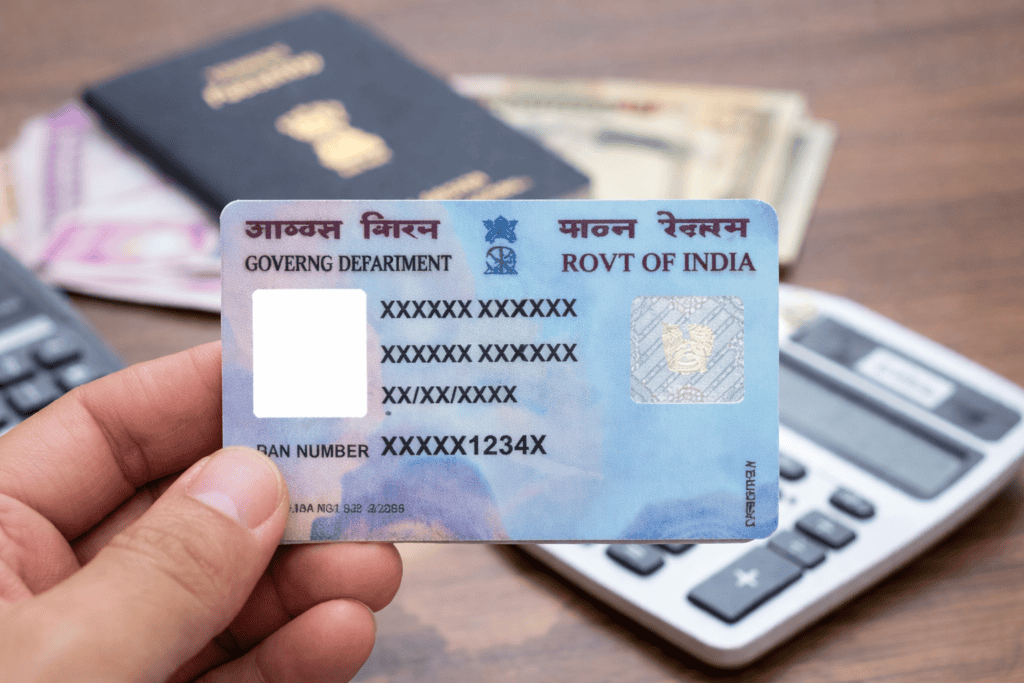
What Does a PAN Card Look Like?
A PAN card issued to an individual contains the following details:
| Detail | Individual PAN Card | Company PAN Card |
|---|---|---|
| Photograph | Yes | No |
| Signature | Yes | No |
| Full Name | Yes | Yes (Company name) |
| Father’s Name | Yes | No |
| Date of Birth | Yes | Date of Registration |
| PAN Number | Yes | Yes |
| QR Code | Yes | Yes |
| Hologram | Yes | Yes |
Why is PAN Card Important? — Where is it Mandatory?
This is the most important section for exam students. PAN is compulsory in the following situations:
| Transaction | PAN Required When |
|---|---|
| Filing Income Tax Return (ITR) | Always mandatory |
| Opening a bank account | Always mandatory |
| Cash deposit in bank | Rs. 50,000 or more in a single day (old rule) / Rs. 10 lakh or more in a year (new rule from April 2026) |
| Fixed Deposit (FD) | Rs. 50,000 or more |
| Buying or selling property | Above Rs. 10 lakh (old rule) / Above Rs. 20 lakh (new rule from April 2026) |
| Buying a vehicle | Any motor vehicle except two-wheelers (old rule) / Above Rs. 5 lakh (new rule from April 2026) |
| Buying jewellery | Rs. 2 lakh or more |
| Paying hotel or restaurant bills | Rs. 50,000 or more (old rule) / Rs. 1 lakh or more (new rule from April 2026) |
| Foreign exchange purchase | Rs. 50,000 or more |
| Investing in mutual funds or shares | Always mandatory for KYC |
| Opening a Demat account | Always mandatory |
| Paying life insurance premium | Rs. 50,000 or more per year |
| GST Registration for businesses | Always mandatory |
Note: New PAN transaction limits under the Income Tax Act 2025 have been revised upward from April 2026 to reduce unnecessary compliance for small transactions.
Who Must Have a PAN Card?
Under Section 139A of the Income Tax Act, PAN is mandatory for:
| Category | PAN Required? |
|---|---|
| Any person paying income tax | Yes |
| Business with turnover above Rs. 5 lakh | Yes |
| Importers and exporters | Yes |
| Companies and firms | Yes |
| Trusts and charitable organisations | Yes |
| Minors (applied by parents or guardians) | Yes, if investments are made in the minor’s name |
| NRIs with income in India | Yes |
| Foreign nationals investing in India | Yes |
Note: There is NO minimum age for PAN. Even a newborn child can have a PAN if their parents apply for it. This is useful when parents invest in a child’s name.
New PAN Rules from April 1, 2026 — Very Important
The Income Tax Act, 2025 has brought major changes to PAN rules effective from April 1, 2026. Every student and taxpayer must know these.
| Change | Old Rule (Before April 2026) | New Rule (From April 2026) |
|---|---|---|
| PAN Application Form for Indians | Form 49A | Form 93 |
| PAN Application Form for NRIs | Form 49AA | Form 95 |
| Documents for new PAN | Only Aadhaar was enough | Voter ID, Passport, Birth Certificate etc. also required |
| Name on PAN Card | Applicant’s preferred name | Must exactly match name on Aadhaar |
| Cash deposit limit requiring PAN | Rs. 50,000 per day | Rs. 10 lakh per year |
| Property transaction limit | Above Rs. 10 lakh | Above Rs. 20 lakh |
| Vehicle purchase limit | All motor vehicles | Only if vehicle costs above Rs. 5 lakh |
| Hotel or event payments | Rs. 50,000 or more | Rs. 1 lakh or more |
Important: Any PAN application pending before March 31, 2026 remains valid. Only new applications filed on or after April 1, 2026 must use the new forms.
How to Apply for PAN Card — Step by Step
There are two ways to apply for a PAN card in India.
Method 1 — Online Application (Recommended)
Step 1: Visit the official website of Protean (formerly NSDL) or the Income Tax e-filing portal
Step 2: Select “Apply for New PAN Card”
Step 3: Choose Form 93 (for Indian citizens) or Form 95 (for NRIs and foreigners)
Step 4: Fill in your personal details — name (as per Aadhaar), date of birth, mobile number, email ID
Step 5: Upload required documents — Aadhaar card, Voter ID or Passport, Birth Certificate
Step 6: Pay the application fee of Rs. 91 (excluding GST) for Indian address or Rs. 862 for foreign address
Step 7: Complete e-verification using Aadhaar-based OTP
Step 8: Your PAN will be processed and sent to your address within 15 working days
Method 2 — Instant e-PAN (Free and Fastest)
This is a completely paperless and free method. It takes only 10 minutes.
Conditions: You must have an Aadhaar number AND your mobile number must be linked to Aadhaar.
Step 1: Go to incometax.gov.in
Step 2: Click “Instant e-PAN”
Step 3: Enter your Aadhaar number
Step 4: Enter the OTP received on your Aadhaar-linked mobile number
Step 5: Your e-PAN (PDF format) is generated instantly and sent to your email
Note: An e-PAN is equally valid as a physical PAN card for all purposes.
Method 3 — Offline Application
Step 1: Download Form 93 from incometax.gov.in
Step 2: Fill the form carefully
Step 3: Attach two passport-sized photographs and required documents
Step 4: Submit at any PAN agency or TIN facilitation centre
Step 5: Pay the fee by demand draft
Application Fee for PAN Card
| Type | Fee (Excluding GST) |
|---|---|
| Indian communication address | Rs. 91 |
| Foreign communication address | Rs. 862 |
| Instant e-PAN | Free |
Documents Required for PAN Card (From April 2026)
For Individual Indian Citizens:
| Document Type | Accepted Documents |
|---|---|
| Proof of Identity | Aadhaar Card, Voter ID, Passport, Driving Licence |
| Proof of Address | Aadhaar Card, Voter ID, Passport, Utility Bill |
| Proof of Date of Birth | Aadhaar Card, Birth Certificate, School Leaving Certificate, Passport |
Note: Name on all documents must match exactly with your Aadhaar card name.
Important Rules You Must Know
| Rule | Details |
|---|---|
| One PAN per person | Having more than one PAN is illegal under Section 272B |
| Penalty for multiple PAN | Rs. 10,000 fine |
| PAN never expires | Once issued, PAN remains valid for life |
| PAN not proof of citizenship | PAN is a tax document, NOT proof of Indian citizenship. NRIs and foreign nationals can also have PAN |
| PAN and Aadhaar linking | PAN must be linked with Aadhaar (if applicable) to keep it active |
| PAN inactivation | Government has already deactivated over 1.1 million duplicate PANs |
Difference Between PAN and Aadhaar — Quick Comparison
Students often confuse PAN and Aadhaar in exams. Here is a clear comparison:
| Feature | PAN Card | Aadhaar Card |
|---|---|---|
| Full Form | Permanent Account Number | Unique Identification Number |
| Issued by | Income Tax Department (CBDT) | UIDAI |
| Purpose | Tax identity and financial tracking | General identity and residency proof |
| Number Type | 10-digit alphanumeric | 12-digit numeric |
| Proof of citizenship | No | No |
| Mandatory for | Tax filing, financial transactions | Government services, subsidies |
| Can NRI apply | Yes | No (only for residents of India) |
Penalty for Not Having PAN When Required
If you are required to quote PAN but fail to do so, or if you give a wrong PAN, you are liable for a penalty under Section 272B of the Income Tax Act.
Penalty amount = Rs. 10,000 per default
Conclusion
PAN Card is not just a piece of plastic. It is the foundation of every financial activity in India — from opening a bank account to filing your income tax return to buying a house. Whether you are a student, a salaried employee, a business owner, or even a minor — understanding what PAN is and where it is required is essential knowledge for every Indian.
From April 2026, the rules around PAN have become stricter with new application forms, additional document requirements, and updated transaction limits. Make sure your PAN details match your Aadhaar exactly to avoid any issues.

Swathika B is an MBA graduate in Finance & Business Analytics , the founder of The Commerce Lab. With a strong academic foundation in B.Com BFSI and hands-on experience in financial analysis, data analytics, and business studies, she created this platform to make Commerce and Accountancy simple, practical, and exam-ready for students across India.