Introduction
Whenever you buy a mobile phone, eat at a restaurant, book a hotel room, or recharge your internet pack, you pay GST.
GST stands for Goods and Services Tax. It is a single indirect tax charged on most goods and services sold in India.
Before GST, India had many different taxes such as VAT, Service Tax, Excise Duty, Entry Tax, Luxury Tax, and Entertainment Tax. This made the tax system very confusing for both businesses and consumers.
To solve this problem, the Government of India introduced GST on July 1, 2017.
In simple words, GST is the tax added to the price whenever you buy something.
Real-Life Example of GST
Suppose you go to a restaurant and order food worth ₹1,000.
The bill may look like this:
- Food Amount = ₹1,000
- GST @ 18% = ₹180
- Final Bill = ₹1,180
Here, the restaurant keeps ₹1,000 for the food and deposits ₹180 to the government as GST.
This is how GST works in daily life.
Full Form of GST
| Letter | Meaning |
|---|---|
| G | Goods |
| S | Services |
| T | Tax |
Goods include products such as clothes, food items, furniture, mobile phones, and vehicles.
Services include hotel stays, banking, tuition classes, mobile recharge, internet, insurance, and transport.
Why Was GST Introduced?
Before GST, India had more than 17 indirect taxes.
Some of the major taxes before GST were:
- VAT (Value Added Tax)
- Service Tax
- Central Excise Duty
- Entry Tax
- Octroi
- Luxury Tax
- Entertainment Tax
- Central Sales Tax
Because of these taxes:
- Products became expensive
- Businesses had to maintain many records
- Different states had different tax rules
- Trucks were stopped at state borders for tax checks
- There was a lot of confusion and delay
GST removed most of these taxes and created a single nationwide tax system.
That is why GST is often called:
“One Nation, One Tax”
How GST Works
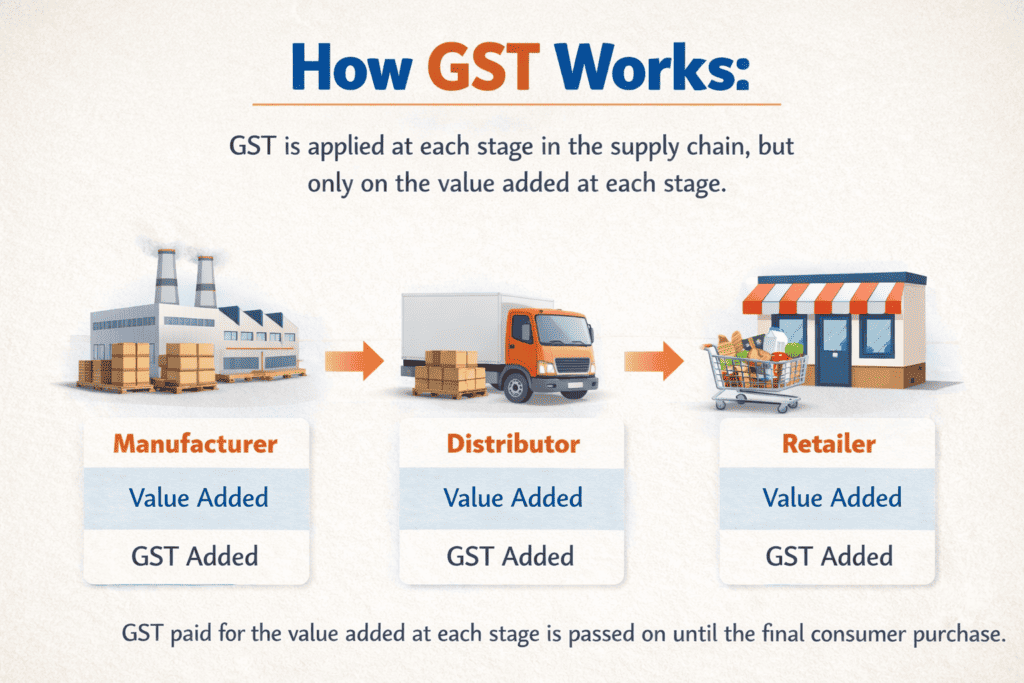
GST is collected at every stage of sale.
However, businesses do not pay tax on the full value every time. They only pay tax on the value they add.
This system is called Input Tax Credit (ITC).
Example of Input Tax Credit
| Stage | Price | GST Collected | ITC Claimed | Net GST Paid |
|---|---|---|---|---|
| Raw Material Supplier | ₹100 | ₹5 | ₹0 | ₹5 |
| Manufacturer | ₹200 | ₹10 | ₹5 | ₹5 |
| Retailer | ₹400 | ₹20 | ₹10 | ₹10 |
| Final Consumer | ₹600 | ₹30 | ₹20 | ₹10 |
In the end, the government receives ₹30, which is exactly 5% of the final value ₹600.
This prevents double taxation.
Types of GST in India
There are four main types of GST in India.
| Type | Full Form | When Applied |
|---|---|---|
| CGST | Central Goods and Services Tax | Within the same state |
| SGST | State Goods and Services Tax | Within the same state |
| IGST | Integrated Goods and Services Tax | Between two states |
| UTGST | Union Territory Goods and Services Tax | In Union Territories |
Example
- If a product is sold from Chennai to Madurai, CGST and SGST will apply.
- If a product is sold from Delhi to Tamil Nadu, IGST will apply.
GST Tax Slabs in India
GST is not charged at the same rate for all products.
| GST Rate | Items Included |
|---|---|
| 0% | Milk, eggs, vegetables, books, newspapers |
| 5% | Tea, coffee, packaged food, medicines |
| 12% | Butter, cheese, umbrellas, fruit juice |
| 18% | Soap, shampoo, toothpaste, restaurants, banking services |
| 28% | Cars, tobacco, luxury hotels, casinos |
Easy Memory Trick
Remember the GST slabs in this order:
0% → 5% → 12% → 18% → 28%
Basic necessities have low or zero GST.
Luxury items have higher GST.
GST Formula
GST can be calculated using a simple formula:
GST Amount = (Original Price × GST Rate) ÷ 100
Example:
If the price of a product is ₹2,000 and GST is 18%:
GST = (2000 × 18) ÷ 100 = ₹360
Final Price = ₹2,000 + ₹360 = ₹2,360
Who Should Register for GST?
A business must register for GST if:
- Annual turnover exceeds ₹40 lakhs for goods
- Annual turnover exceeds ₹20 lakhs for services
- The business sells products in different states
- The business sells through e-commerce websites
- The business imports or exports goods and services
Small businesses below the limit do not need GST registration.
GST Registration Process
The GST registration process is completely online.
Steps to Register for GST
- Visit the GST portal
- Click on “Register Now”
- Enter PAN number, mobile number, and email ID
- Verify OTP
- Fill business details
- Upload required documents
- Submit the application
- Receive GSTIN number after approval
Documents Required for GST Registration
The following documents are usually needed:
- PAN card of the business or owner
- Aadhaar card
- Passport-size photograph
- Business address proof
- Bank account details
- Electricity bill or rent agreement
- Business registration proof
What is GSTIN?
GSTIN stands for Goods and Services Tax Identification Number.
It is a 15-digit number given to every registered business.
This number is used for:
- Filing GST returns
- Paying GST
- Claiming Input Tax Credit
- Issuing tax invoices
GST Returns
Every registered business must file GST returns.
A GST return is a document that shows:
- Total sales
- Total purchases
- GST collected
- GST paid
| Return Type | Purpose |
|---|---|
| GSTR-1 | Details of sales |
| GSTR-3B | Monthly tax payment summary |
| GSTR-9 | Annual return |
| GSTR-4 | Return for composition scheme taxpayers |
Composition Scheme Under GST
Small businesses can choose the Composition Scheme if their turnover is low.
| Feature | Regular GST | Composition Scheme |
|---|---|---|
| Tax Rate | Different slabs | Lower flat rate |
| Return Filing | Monthly | Quarterly |
| ITC Benefit | Available | Not Available |
| Inter-State Sales | Allowed | Not Allowed |
This scheme is useful for small shops and local businesses.
Advantages of GST
GST has many benefits for India.
Benefits of GST
- Replaced multiple taxes with one tax
- Reduced confusion in the tax system
- Made business easier across states
- Reduced hidden taxes on products
- Increased tax transparency
- Improved government revenue collection
- Reduced transport delays at state borders
- Encouraged digital tax filing
Disadvantages of GST
Although GST has many benefits, it also has some challenges.
Challenges of GST
- Filing returns can be difficult for small businesses
- Some services became costlier after GST
- Businesses need internet and software for filing
- Frequent rule changes can create confusion
- Small traders may find compliance expensive
GST vs VAT
| Basis | GST | VAT |
|---|---|---|
| Meaning | Goods and Services Tax | Value Added Tax |
| Coverage | Goods and Services | Mainly Goods |
| Tax Structure | One nationwide system | Different in each state |
| Number of Taxes | Single tax | Multiple taxes |
| Complexity | Less | More |
Latest GST Updates for 2026
Some important GST-related developments in 2026 include:
- Increased focus on digital GST compliance
- Faster GST refunds for exporters
- Better AI-based checking of fake invoices
- Stronger monitoring of e-commerce sellers
- Simplified return filing for small businesses
Important GST Questions for Exams
- What is the full form of GST?
- When was GST introduced in India?
- What are the different types of GST?
- What is Input Tax Credit?
- What are the GST tax slabs?
- What is GSTIN?
- What is the difference between CGST and IGST?
- What is the Composition Scheme?
- What is the turnover limit for GST registration?
- What is the motto of GST?
Quick Revision Table
| Feature | Details |
|---|---|
| Full Form | Goods and Services Tax |
| Launch Date | July 1, 2017 |
| Constitutional Amendment | 101st Amendment Act, 2016 |
| Main Feature | Input Tax Credit |
| Tax Type | Indirect Tax |
| Types | CGST, SGST, IGST, UTGST |
| Slabs | 0%, 5%, 12%, 18%, 28% |
| Registration Limit for Goods | ₹40 Lakhs |
| Registration Limit for Services | ₹20 Lakhs |
| Governing Body | GST Council |
Conclusion
GST is one of the most important tax reforms in India.
It replaced many confusing taxes with one simple system. Today, GST is used across the country for almost every product and service.
Understanding GST helps students, business owners, and common people understand bills, taxes, and the Indian economy more clearly.
Whether you are preparing for exams, running a business, or simply trying to understand your shopping bill, knowing GST is very useful.
Understanding taxes today means making smarter financial decisions tomorrow.

Swathika B is an MBA graduate in Finance & Business Analytics , the founder of The Commerce Lab. With a strong academic foundation in B.Com BFSI and hands-on experience in financial analysis, data analytics, and business studies, she created this platform to make Commerce and Accountancy simple, practical, and exam-ready for students across India.