Introduction
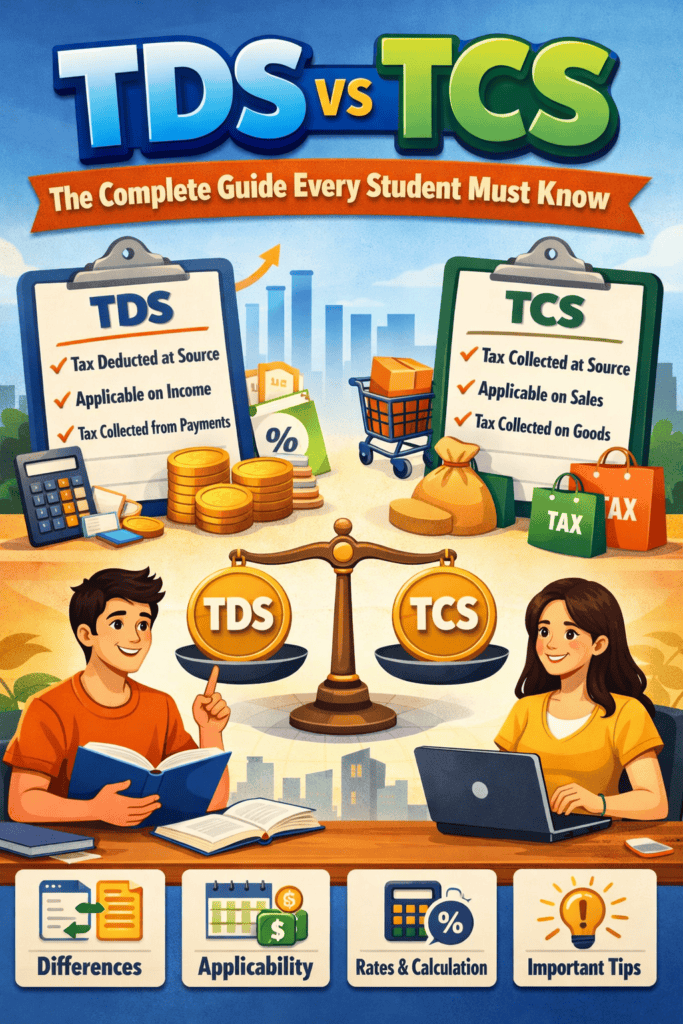
Every month when a salaried employee gets their salary, a certain amount is already deducted before the money reaches their bank account. Ever wondered what that deduction is? That’s TDS — Tax Deducted at Source.
Similarly, when a seller sells certain goods like scrap or timber, the buyer deducts a small tax before paying. That’s TCS — Tax Collected at Source.
Both TDS and TCS are methods used by the Indian government to collect income tax in advance — before you file your return at the end of the year. They ensure tax reaches the government throughout the year and reduce tax evasion.
| Simple rule: TDS = Tax deducted by the PAYER before making payment. TCS = Tax collected by the SELLER from the BUYER at the time of sale. |
What is TDS? (Tax Deducted at Source)
TDS is a mechanism where the person making a payment deducts a certain percentage of tax before paying the receiver. The deducted amount is deposited directly with the government on behalf of the receiver.
Real Life Example of TDS:
Ramesh is a freelancer. He does a ₹1,00,000 project for ABC Company. Instead of paying ₹1,00,000, ABC Company deducts 10% TDS = ₹10,000 and pays Ramesh only ₹90,000. The ₹10,000 goes directly to the government as advance tax on Ramesh’s behalf.
| Who Deducts TDS? | On What Payment? | TDS Rate |
| Employer | Salary paid to employee | As per income tax slab |
| Company / Firm | Professional fees / consultancy | 10% |
| Bank | Interest on Fixed Deposit (>₹40,000) | 10% |
| Company / Individual | Rent (>₹50,000/month) | 2% (individual), 10% (company) |
| Buyer of property | Purchase of immovable property (>₹50 lakhs) | 1% |
| Company | Commission or brokerage | 5% |
| Company | Winning from lottery / game shows | 30% |
What is TCS? (Tax Collected at Source)
TCS is collected by the SELLER from the BUYER at the time of sale of specified goods or services. The seller then deposits this collected tax with the government.
Real Life Example of TCS:
Suresh buys scrap metal worth ₹5,00,000 from a scrap dealer. The scrap dealer collects 1% TCS = ₹5,000 extra from Suresh and deposits it with the government. Suresh pays ₹5,05,000 total.
| Goods / Transaction | TCS Rate |
| Scrap (waste material) | 1% |
| Timber obtained under a forest lease | 2.5% |
| Timber obtained by any other mode | 2.5% |
| Tendu leaves | 5% |
| Forest produce (other than timber/tendu leaves) | 2.5% |
| Alcoholic liquor for human consumption | 1% |
| Motor vehicles (value > ₹10 lakhs) | 1% |
| Foreign remittance under LRS (>₹7 lakhs) | 5% (20% without PAN) |
| Sale of goods (turnover > ₹10 crore — seller) | 0.1% |
| Overseas tour packages | 5% |
TDS vs TCS — Key Differences (20 Points)
| Point | TDS | TCS |
| Full Form | Tax Deducted at Source | Tax Collected at Source |
| Who deducts/collects? | The PAYER (buyer/employer) | The SELLER (who receives money) |
| When? | At the time of making payment | At the time of receiving payment / sale |
| Who bears the tax? | The RECEIVER (payee) | The BUYER |
| Applicable on | Payments: salary, interest, rent, fees, commission | Sale of specified goods |
| Governing Section | Section 192 to 196D of Income Tax Act | Section 206C of Income Tax Act |
| Certificate Issued | Form 16 (salary) / Form 16A (others) | Form 27D |
| TDS/TCS Return | Form 24Q (salary), 26Q (others) | Form 27EQ |
| Due Date to Deposit | 7th of next month (March — 30th April) | 7th of next month |
| Threshold Limit | Varies by payment type (e.g. FD > ₹40,000) | Varies by goods (e.g. vehicle > ₹10L) |
| Credit to taxpayer | Shown in Form 26AS / AIS | Shown in Form 26AS / AIS |
| Lower deduction option | Yes — Form 13 application | Yes — application to AO |
| Nil deduction option | Yes — Form 15G/15H (for FD) | Not commonly available |
| Nature | Deduction from payment | Collection over and above payment |
| Common examples | Salary TDS, Bank FD TDS, contractor TDS | Scrap TCS, vehicle TCS, foreign remittance TCS |
| Impact on cash flow | Receiver gets less money upfront | Buyer pays more money upfront |
| Deposited by | Deductor (payer) | Collector (seller) |
| Refund possible? | Yes, if excess TDS — claim in ITR | Yes, if excess TCS — claim in ITR |
| PAN mandatory? | Yes — higher rate (20%) if no PAN | Yes — higher rate (20%) if no PAN |
| Part of advance tax? | Yes — reduces final tax liability | Yes — reduces final tax liability |
TDS on Salary — Detailed Explanation
TDS on salary is governed by Section 192 of the Income Tax Act. Your employer deducts TDS from your salary every month based on your estimated annual income and the applicable income tax slab.
How is Salary TDS Calculated?
- Employer estimates your total annual salary at the start of the year
- They subtract all eligible deductions (HRA, 80C, 80D, Standard Deduction ₹75,000 etc.)
- They calculate income tax on the net taxable income as per the slab rates
- This total annual tax is divided by 12 months
- Each month, that amount is deducted from your salary as TDS
Example: Salary TDS Calculation
| Particulars | Amount |
| Annual CTC (Gross Salary) | ₹8,00,000 |
| Less: Standard Deduction | ₹75,000 |
| Less: HRA Exemption | ₹60,000 |
| Less: 80C Investments (PF, ELSS etc.) | ₹1,50,000 |
| Net Taxable Income | ₹5,15,000 |
| Income Tax (New Regime 2025-26) | ₹13,000 approx |
| Monthly TDS (₹13,000 ÷ 12) | ₹1,083/month |
Form 16 — TDS Certificate for Salary
Form 16 is a TDS certificate issued by your employer every year (by June 15) showing how much salary was paid to you and how much TDS was deducted.
Form 16 has Two Parts:
| Part | Contains | Issued by |
| Part A | Employer details, employee details, PAN, TAN, total TDS deposited quarter-wise | Downloaded from TRACES portal by employer |
| Part B | Detailed salary breakup — HRA, allowances, perquisites, deductions (80C, 80D etc.), net taxable income | Prepared by employer |
Why is Form 16 Important?
- It is the primary document for filing your Income Tax Return (ITR)
- Banks and financial institutions ask for Form 16 for loan approvals
- It serves as proof of income and TDS payment
- If TDS deducted > actual tax liability → you get a refund using Form 16 data
| Tip: Even if your employer does not deduct TDS (income below taxable limit), you should still get Form 16 Part B as a salary statement for your records. |
Form 26AS — Your Tax Passbook
Form 26AS is a consolidated tax statement available on the Income Tax portal. It shows ALL tax deducted/collected on your behalf by various deductors — employer, bank, buyer etc.
- TDS by employer (salary)
- TDS by bank (FD interest)
- TCS collected from you (vehicle purchase, foreign remittance etc.)
- Advance tax paid by you
- Self-assessment tax paid
Access Form 26AS: Income Tax Portal → Login → e-File → View Form 26AS
Solved Problems — TDS & TCS Numericals
| Problem 1: TDS on Professional Fees |
| Given: ABC Pvt Ltd pays ₹80,000 as consultancy fees to Mr. Sharma (a CA). What is the TDS to be deducted? How much will Mr. Sharma receive? |
| Solution: TDS Rate on professional fees = 10% (Section 194J) TDS = 10% × ₹80,000 = ₹8,000 Amount paid to Mr. Sharma = ₹80,000 − ₹8,000 = ₹72,000 ABC Pvt Ltd deposits ₹8,000 with the government. |
| ✅ Answer: TDS = ₹8,000 | Net Payment to Mr. Sharma = ₹72,000 |
| Problem 2: TDS on Fixed Deposit Interest |
| Given: Mrs. Priya has a Fixed Deposit of ₹5,00,000 at 8% per annum interest in SBI. She has not submitted Form 15G. Calculate TDS deducted by the bank. |
| Solution: Annual Interest = 8% × ₹5,00,000 = ₹40,000 Threshold limit for TDS on FD interest = ₹40,000 (for non-senior citizens) Since interest = ₹40,000 (equals threshold), TDS applies. TDS Rate = 10% (Section 194A) TDS = 10% × ₹40,000 = ₹4,000 Net interest credited to Mrs. Priya = ₹40,000 − ₹4,000 = ₹36,000 |
| ✅ Answer: TDS = ₹4,000 | Net Interest = ₹36,000 |
| Problem 3: TCS on Sale of Scrap |
| Given: XYZ Scrap Dealers sells scrap worth ₹3,00,000 to Ravi Industries. Calculate TCS to be collected. How much will Ravi Industries pay in total? |
| Solution: TCS Rate on Scrap = 1% (Section 206C) TCS = 1% × ₹3,00,000 = ₹3,000 Total amount paid by Ravi Industries = ₹3,00,000 + ₹3,000 = ₹3,03,000 XYZ Scrap Dealers deposits ₹3,000 with the government. |
| ✅ Answer: TCS = ₹3,000 | Total Payment by Buyer = ₹3,03,000 |
| Problem 4: TDS on Salary (Monthly Deduction) |
| Given: Mr. Arun’s annual taxable salary (after all deductions) is ₹7,50,000. He is under the New Tax Regime. Calculate monthly TDS to be deducted by his employer. |
| Solution: Taxable Income = ₹7,50,000 New Regime Tax Calculation: – ₹0 to ₹4,00,000 → Nil – ₹4,00,001 to ₹8,00,000 → 5% – Tax on ₹3,50,000 @ 5% = ₹17,500 Add: Health & Education Cess @ 4% = ₹700 Total Annual Tax = ₹18,200 Monthly TDS = ₹18,200 ÷ 12 = ₹1,517 (approx) |
| ✅ Answer: Monthly TDS = ₹1,517 approx | Annual TDS = ₹18,200 |
| Problem 5: TCS on Motor Vehicle Purchase |
| Given: Mr. Vikram buys a car worth ₹15,00,000 from a dealer. Calculate TCS to be collected by the dealer. |
| Solution: Car value = ₹15,00,000 (exceeds ₹10,00,000 threshold) TCS Rate on Motor Vehicle = 1% (Section 206C(1F)) TCS = 1% × ₹15,00,000 = ₹15,000 Total amount paid by Mr. Vikram = ₹15,00,000 + ₹15,000 = ₹15,15,000 The dealer deposits ₹15,000 with the government. |
| ✅ Answer: TCS = ₹15,000 | Total Paid by Buyer = ₹15,15,000 |
| Problem 6: TDS on Rent (Section 194I) |
| Given: Deepak pays ₹60,000 per month as office rent to a company. Is TDS applicable? If yes, calculate annual TDS. |
| Solution: Threshold for TDS on rent = ₹2,40,000 per year Annual rent = ₹60,000 × 12 = ₹7,20,000 (exceeds threshold) TDS is APPLICABLE. TDS Rate on rent paid to company = 10% (Section 194I) Annual TDS = 10% × ₹7,20,000 = ₹72,000 Monthly TDS to be deducted = ₹72,000 ÷ 12 = ₹6,000 |
| ✅ Answer: Annual TDS = ₹72,000 | Monthly TDS = ₹6,000 |
| Problem 7: No PAN — Higher TDS Rate |
| Given: A contractor receives payment of ₹50,000 but has NOT provided his PAN to the payer. What TDS rate applies? |
| Solution: Normal TDS rate on contractor payments (Section 194C) = 1% (individual) or 2% (company) However, if PAN is NOT provided, TDS must be deducted at HIGHER of: (a) Rate specified in the Act = 1% (b) Rate in force = 1% (c) 20% (flat rate without PAN) Highest rate applies = 20% TDS = 20% × ₹50,000 = ₹10,000 |
| ✅ Answer: TDS without PAN = ₹10,000 (20% rate applies) |
Must-Know Exam Points 📝
- TDS = deducted by payer | TCS = collected by seller
- TDS governed by Sections 192–196D | TCS governed by Section 206C
- TDS certificate for salary = Form 16 | For others = Form 16A
- TCS certificate = Form 27D
- All TDS/TCS visible in Form 26AS (Tax Passbook)
- No PAN provided → TDS/TCS at 20% flat rate
- Senior citizens (above 60) can submit Form 15H to avoid TDS on FD interest
- Non-senior citizens submit Form 15G to avoid TDS on FD interest
- TDS due date: 7th of next month (except March — due 30th April)
- TDS return: Form 24Q (salary), Form 26Q (non-salary), Form 27Q (NRI)
- TCS return: Form 27EQ filed quarterly
- Both TDS and TCS are part of advance tax — credited against final tax liability
Quick Revision Table
| Feature | TDS | TCS |
| Full Form | Tax Deducted at Source | Tax Collected at Source |
| Who does it? | Payer (buyer/employer) | Seller/Collector |
| Applicable on | Payments (salary, fees, rent, interest) | Sale of specified goods |
| Section | 192 to 196D | 206C |
| Certificate | Form 16 / Form 16A | Form 27D |
| Return Form | 24Q / 26Q / 27Q | 27EQ |
| No PAN rate | 20% | 20% |
| Nil TDS option | Form 15G / 15H / Form 13 | Application to AO |
| Due date | 7th of following month | 7th of following month |
| Refund | Yes, through ITR filing | Yes, through ITR filing |
Conclusion
TDS and TCS are the government’s smart way of collecting tax throughout the year — instead of waiting until March. For salaried employees, TDS on salary is the most common encounter. For businesses, TDS on contractor payments, rent, and professional fees is routine.
Understanding TDS and TCS not only helps you in exams but also helps you in real life — you will know why your salary is less than CTC, why your FD interest is lower than expected, and how to claim refunds through your ITR.
Study Smart. Score High. Keep Growing! 🚀

Swathika B is an MBA graduate in Finance & Business Analytics , the founder of The Commerce Lab. With a strong academic foundation in B.Com BFSI and hands-on experience in financial analysis, data analytics, and business studies, she created this platform to make Commerce and Accountancy simple, practical, and exam-ready for students across India.