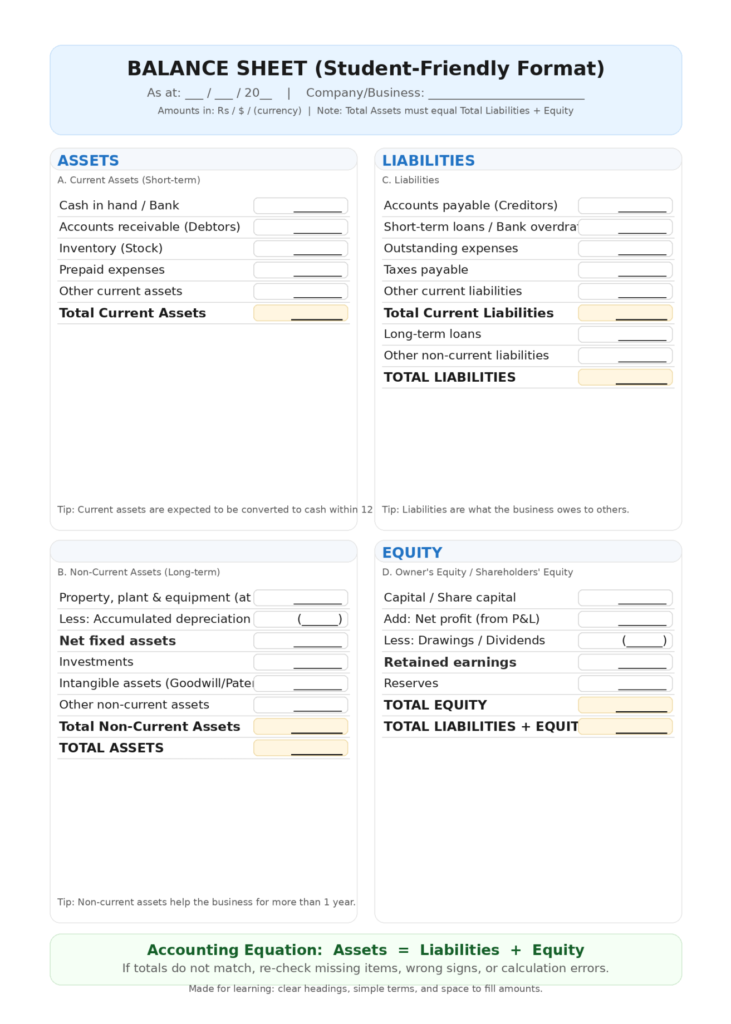
The Balance Sheet is one of the most important financial statements in accounting. It shows the financial position of a business on a particular date. It helps students, business owners and investors understand what the business owns and what the business owes.
A Balance Sheet is prepared at the end of the accounting year and is based on the accounting equation:
Assets = Liabilities + Capital
This means that the total value of assets must always be equal to the total of liabilities and capital.
A Balance Sheet is a statement that shows the assets, liabilities and capital of a business at a specific date.
It helps to know:
The financial strength of the business The amount invested by the owner The debts payable by the business The total assets available in the business The liquidity and solvency position of the business Objective Explanation To know the financial position Shows the financial condition of the business To know the liquidity position Shows whether current liabilities can be paid on time To know the solvency position Helps understand long-term financial stability To know the owner’s capital Shows the amount invested by the owner To compare business growth Helps compare performance over different years
Liabilities Side Assets Side Capital Fixed Assets Long-term Liabilities Intangible Assets Current Liabilities Current Assets Outstanding Expenses Cash and Bank Balance
Liabilities Amount (₹) Assets Amount (₹) Capital XX Fixed Assets XX Non-Current Liabilities XX Non-Current Investments XX Current Liabilities XX Current Assets XX Outstanding Expenses XX Cash and Bank XX Total XXX Total XXX
Type of Asset Meaning Examples Fixed Assets Assets used for a long period in business Land, Building, Machinery, Furniture Intangible Assets Assets without physical existence Goodwill, Patent, Trademark Current Assets Assets converted into cash within one year Cash, Stock, Debtors, Bank Balance Fictitious Assets Expenses not yet written off completely Preliminary Expenses, Discount on Issue of Shares
Type of Liability Meaning Examples Capital Amount invested by the owner Owner’s Capital Non-Current Liabilities Liabilities payable after one year Bank Loan, Debentures Current Liabilities Liabilities payable within one year Creditors, Bills Payable Contingent Liabilities Possible future liabilities Legal Claims, Bills Discounted
Item Explanation Land and Building Permanent property used in business Machinery Equipment used in production Furniture Tables, chairs and office items Stock Unsold goods available in business Debtors Amount receivable from customers Cash in Hand Money available in business Bank Balance Money available in bank account Prepaid Expenses Expenses paid in advance
Item Explanation Capital Amount invested by owner Creditors Amount payable to suppliers Bills Payable Written promise to pay debt Bank Loan Loan taken from bank Outstanding Expenses Expenses due but not paid Bank Overdraft Excess amount withdrawn from bank
Type of Asset Meaning Examples Fixed Assets Assets used for a long period in business Land, Building, Machinery, Furniture Intangible Assets Assets without physical existence Goodwill, Patent, Trademark Current Assets Assets converted into cash within one year Cash, Stock, Debtors, Bank Balance Fictitious Assets Expenses not yet written off completely Preliminary Expenses, Discount on Issue of Shares
Type of Liability Meaning Examples Capital Owner’s investment in the business Capital introduced by proprietor Non-Current Liabilities Liabilities payable after one year Bank Loan, Debentures Current Liabilities Liabilities payable within one year Creditors, Bills Payable, Bank Overdraft Contingent Liabilities Possible future liabilities Bills Discounted, Legal Claims
Prepare a Balance Sheet from the following:
Capital = ₹1,00,000 Creditors = ₹10,000 Machinery = ₹50,000 Stock = ₹40,000 Cash = ₹20,000 Liabilities Amount (₹) Assets Amount (₹) Capital 1,00,000 Machinery 50,000 Creditors 10,000 Stock 40,000 Cash 20,000 Total 1,10,000 Total 1,10,000
Particulars Amount (₹) Capital 1,80,000 Add: Net Profit 20,000 Adjusted Capital 2,00,000
Liabilities Amount (₹) Assets Amount (₹) Capital 2,00,000 Building 2,00,000 Bank Loan 50,000 Furniture 20,000 Bills Payable 10,000 Debtors 30,000 Closing Stock 10,000 Total 2,60,000 Total 2,60,000
Adjustment Calculation Effect Depreciation on Plant 10% of ₹4,00,000 = ₹40,000 Deduct from Plant Value Provision for Doubtful Debts 5% of ₹1,00,000 = ₹5,000 Deduct from Debtors Outstanding Salary Given ₹5,000 Add to Current Liabilities Net Profit Adjustment ₹60,000 – ₹40,000 – ₹5,000 = ₹15,000 Add to Capital
Particulars Amount (₹) Original Plant Value 4,00,000 Less: Depreciation @ 10% 40,000 Net Plant Value 3,60,000
Particulars Amount (₹) Debtors 1,00,000 Less: Provision for Doubtful Debts @ 5% 5,000 Net Debtors 95,000
Particulars Amount (₹) Capital 5,00,000 Add: Net Profit 15,000 Adjusted Capital 5,15,000
Liabilities Amount (₹) Assets Amount (₹) Capital 5,15,000 Plant 3,60,000 Creditors 80,000 Debtors 95,000 Outstanding Salaries 5,000 Cash 1,45,000 Total 6,00,000 Total 6,00,000
Adjustment Trading Account Profit & Loss Account Balance Sheet Closing Stock Credit Side – Asset Side Outstanding Expenses – Added to Expense Liability Side Prepaid Expenses – Deducted from Expense Asset Side Depreciation – Debit Side Deduct from Asset Bad Debts – Debit Side Deduct from Debtors Provision for Doubtful Debts – Debit Side Deduct from Debtors Accrued Income – Credit Side Asset Side
Extra Practice Sums Item Amount (₹) Capital 2,50,000 Creditors 30,000 Cash 20,000 Machinery 1,60,000 Stock 1,00,000
Liabilities Amount (₹) Assets Amount (₹) Capital 2,50,000 Machinery 1,60,000 Creditors 30,000 Stock 1,00,000 Cash 20,000 Total 2,80,000 Total 2,80,000
Swathika B is an MBA graduate in Finance & Business Analytics , the founder of The Commerce Lab. With a strong academic foundation in B.Com BFSI and hands-on experience in financial analysis, data analytics, and business studies, she created this platform to make Commerce and Accountancy simple, practical, and exam-ready for students across India.