1. Introduction
Every business exists to earn profit. But how do we measure that profit? The answer lies in two powerful financial statements — the Trading Account and the Profit & Loss Account. Together, they form the backbone of a firm’s financial performance analysis.
These two accounts are prepared at the end of every accounting period to find:
- The Gross Profit or Gross Loss (Trading Account)
- The Net Profit or Net Loss (P&L Account)
2. Trading Account
2.1 What is a Trading Account?
A Trading Account is the first section of the Final Accounts. It is prepared to ascertain the Gross Profit or Gross Loss from the buying and selling of goods during a financial year.
It records only those items directly related to the purchase and sale of goods — nothing else.
Key Formula: Gross Profit = Net Sales − Cost of Goods Sold (COGS)
2.2 Proforma (Format) of Trading Account
TRADING ACCOUNT
For the year ended 31st March, 20XX
| Dr Side (Debit) | ₹ | Cr Side (Credit) | ₹ |
| Opening Stock | ××× | Sales | ××× |
| Add: Purchases | ××× | Less: Sales Returns | (×××) |
| Less: Purchase Returns | (×××) | Net Sales | ××× |
| Net Purchases | ××× | Closing Stock | ××× |
| Add: Direct Expenses | |||
| Carriage Inwards | ××× | ||
| Wages | ××× | ||
| Factory Rent | ××× | ||
| Import Duty | ××× | ||
| Octroi / Dock Charges | ××× | ||
| Gross Profit (Bal. Fig.) | ××× | ||
| TOTAL | ××× | TOTAL | ××× |
2.3 Items on Each Side
Debit Side (Dr) — All Costs
- Opening Stock — goods at the beginning of the period
- Net Purchases = Purchases − Purchase Returns
- Direct Expenses: Carriage Inwards, Wages, Factory Rent, Power, Fuel, Import Duty, Octroi
Credit Side (Cr) — All Revenues
- Net Sales = Sales − Sales Returns
- Closing Stock — goods at the end of the period
2.4 Important Concepts
Cost of Goods Sold (COGS):
COGS = Opening Stock + Net Purchases + Direct Expenses − Closing Stock
Gross Profit Ratio:
GP Ratio = (Gross Profit / Net Sales) × 100
Solved Problem 1 — Beginner (Trading Account)
From the following information, prepare a Trading Account for M/s Sharma Traders for the year ended 31st March 2024:
| Particulars | Amount (₹) |
| Opening Stock | 40,000 |
| Purchases | 2,50,000 |
| Purchase Returns | 10,000 |
| Sales | 4,50,000 |
| Sales Returns | 20,000 |
| Carriage Inwards | 8,000 |
| Wages | 12,000 |
| Closing Stock | 60,000 |
Solution:
| Dr | ₹ | Cr | ₹ |
| Opening Stock | 40,000 | Sales | 4,50,000 |
| Purchases | 2,50,000 | Less: Sales Returns | (20,000) |
| Less: Purchase Returns | (10,000) | Net Sales | 4,30,000 |
| Net Purchases | 2,40,000 | Closing Stock | 60,000 |
| Carriage Inwards | 8,000 | ||
| Wages | 12,000 | ||
| Gross Profit c/d | 1,90,000 | ||
| TOTAL | 4,90,000 | TOTAL | 4,90,000 |
Gross Profit = Net Sales − COGS = 4,30,000 − (40,000 + 2,40,000 + 20,000 − 60,000) = ₹1,90,000
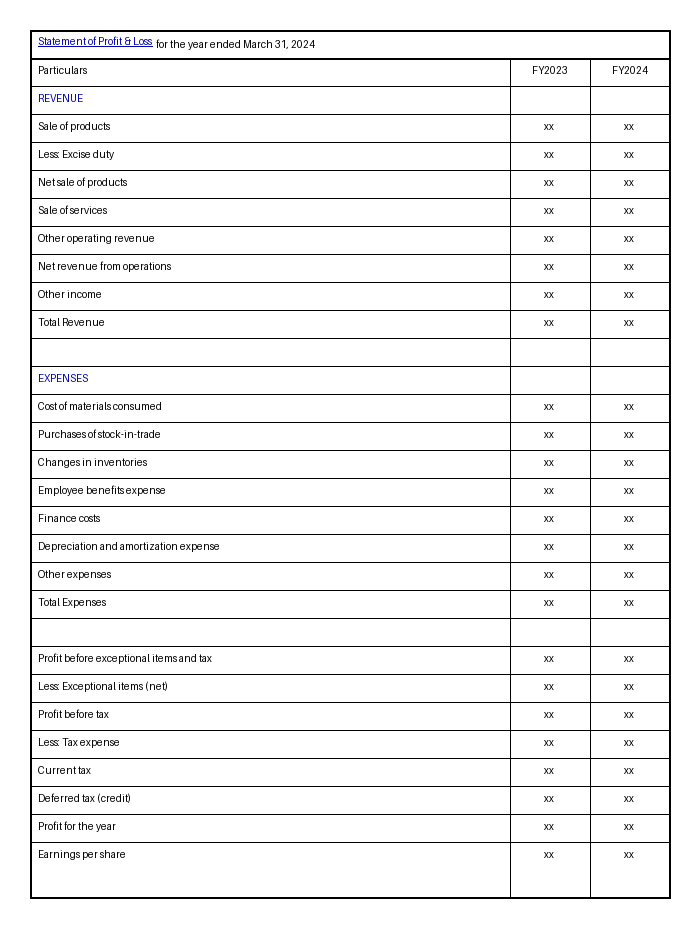
3. Profit & Loss Account
3.1 What is a P&L Account?
The Profit & Loss Account is prepared after the Trading Account. It starts with the Gross Profit (or Gross Loss) brought down from the Trading Account and then records all INDIRECT incomes and INDIRECT expenses to arrive at the Net Profit or Net Loss.
Net Profit = Gross Profit + Indirect Incomes − Indirect Expenses
3.2 Proforma (Format) of P&L Account
| Dr Side — Expenses | ₹ | Cr Side — Incomes | ₹ |
| Gross Loss b/d (if any) | ××× | Gross Profit b/d | ××× |
| Salaries | ××× | Commission Received | ××× |
| Rent (Office/Showroom) | ××× | Discount Received | ××× |
| Insurance Premium | ××× | Interest Received | ××× |
| Advertisement | ××× | Dividend Received | ××× |
| Carriage Outwards | ××× | Rent Received | ××× |
| Printing & Stationery | ××× | Profit on Sale of Asset | ××× |
| Depreciation | ××× | Bad Debts Recovered | ××× |
| Bad Debts | ××× | ||
| Provision for Bad Debts | ××× | ||
| Interest on Capital | ××× | ||
| Interest on Loan (Payable) | ××× | ||
| Net Profit c/d | ××× | Net Loss c/d (if any) | ××× |
| TOTAL | ××× | TOTAL | ××× |
3.3 Classification: Direct vs Indirect
| Direct Expenses (Trading A/c) | Indirect Expenses (P&L A/c) |
| Wages & Salaries (factory) | Office Salaries |
| Carriage Inwards | Carriage Outwards |
| Factory Rent & Power | Office/Shop Rent |
| Import Duty / Octroi | Advertisement |
| Coal, Gas, Water (factory) | Depreciation |
| Packaging (production) | Bad Debts |
Solved Problem 2 — Intermediate (Trading & P&L Account)
Prepare Trading and Profit & Loss Account for M/s Kapoor & Sons for the year ended 31st March 2024:
| Particulars | ₹ | Particulars | ₹ |
| Opening Stock | 80,000 | Sales | 7,20,000 |
| Purchases | 4,50,000 | Sales Returns | 20,000 |
| Purchase Returns | 15,000 | Commission Received | 18,000 |
| Wages | 25,000 | Discount Received | 5,000 |
| Carriage Inwards | 10,000 | Closing Stock | 1,20,000 |
| Salaries | 60,000 | ||
| Rent (Office) | 24,000 | ||
| Advertisement | 15,000 | ||
| Bad Debts | 8,000 | ||
| Depreciation | 12,000 |
Step 1 — Trading Account:
| Dr | ₹ | Cr | ₹ |
| Opening Stock | 80,000 | Net Sales (7,20,000−20,000) | 7,00,000 |
| Net Purchases (4,50,000−15,000) | 4,35,000 | Closing Stock | 1,20,000 |
| Wages | 25,000 | ||
| Carriage Inwards | 10,000 | ||
| Gross Profit c/d | 2,70,000 | ||
| TOTAL | 8,20,000 | TOTAL | 8,20,000 |
Step 2 — Profit & Loss Account:
| Dr | ₹ | Cr | ₹ |
| Salaries | 60,000 | Gross Profit b/d | 2,70,000 |
| Rent (Office) | 24,000 | Commission Received | 18,000 |
| Advertisement | 15,000 | Discount Received | 5,000 |
| Bad Debts | 8,000 | ||
| Depreciation | 12,000 | ||
| Net Profit c/d | 1,74,000 | ||
| TOTAL | 2,93,000 | TOTAL | 2,93,000 |
Net Profit = 2,70,000 + 18,000 + 5,000 − 60,000 − 24,000 − 15,000 − 8,000 − 12,000 = ₹1,74,000
4. Adjustments in Final Accounts
Adjustments are items given outside the Trial Balance (in notes). They appear TWICE — once in Trading/P&L and once in the Balance Sheet. This is the most exam-tested area.
| Adjustment | Trading / P&L Effect | Balance Sheet Effect |
| Closing Stock | Add to Cr side of Trading A/c | Asset (Current Assets) |
| Outstanding Expense | Add to expense in P&L | Liability (Current Liabilities) |
| Prepaid Expense | Deduct from expense in P&L | Asset (Current Assets) |
| Accrued Income | Add to income in P&L | Asset (Current Assets) |
| Income Received in Advance | Deduct from income in P&L | Liability (Current Liabilities) |
| Depreciation | Add to P&L Dr side | Deduct from Fixed Asset |
| Bad Debts | Add to P&L Dr side | Deduct from Debtors |
| Provision for Bad Debts | Add to P&L Dr side | Deduct from Debtors |
| Interest on Capital | Add to P&L Dr side | Add to Capital in B/S |
| Interest on Drawings | Less from P&L Dr side | Deduct from Capital |
5. Advanced Problem — With Adjustments
From the following Trial Balance of M/s Mehta & Co., prepare Trading and P&L Account for the year ended 31st March 2024:
| Particulars | Dr (₹) | Cr (₹) |
| Opening Stock | 1,00,000 | — |
| Purchases | 6,00,000 | — |
| Sales | — | 10,00,000 |
| Wages | 45,000 | — |
| Carriage Inwards | 15,000 | — |
| Salaries | 90,000 | — |
| Rent (Office) | 36,000 | — |
| Advertisement | 24,000 | — |
| Insurance Premium | 18,000 | — |
| Bad Debts | 10,000 | — |
| Discount Received | — | 12,000 |
| Commission Received | — | 30,000 |
Adjustments:
- Closing Stock: ₹1,50,000
- Outstanding Salaries: ₹10,000
- Prepaid Insurance: ₹3,000
- Depreciate Furniture by 10% (Furniture = ₹80,000)
- Provision for Doubtful Debts @ 5% on Debtors (Debtors = ₹2,00,000)
SOLUTION — Trading Account:
| Dr | ₹ | Cr | ₹ |
| Opening Stock | 1,00,000 | Sales (Net) | 10,00,000 |
| Purchases | 6,00,000 | Closing Stock (Adj.) | 1,50,000 |
| Wages | 45,000 | ||
| Carriage Inwards | 15,000 | ||
| Gross Profit c/d | 3,90,000 | ||
| TOTAL | 11,50,000 | TOTAL | 11,50,000 |
SOLUTION — Profit & Loss Account:
| Dr | ₹ | Cr | ₹ |
| Salaries (90,000 + 10,000 Out.) | 1,00,000 | Gross Profit b/d | 3,90,000 |
| Rent (Office) | 36,000 | Discount Received | 12,000 |
| Advertisement | 24,000 | Commission Received | 30,000 |
| Insurance (18,000 − 3,000 Prepaid) | 15,000 | ||
| Bad Debts | 10,000 | ||
| Provision for Bad Debts (5% × 2L) | 10,000 | ||
| Depreciation on Furniture (10%) | 8,000 | ||
| Net Profit c/d | 2,29,000 | ||
| TOTAL | 4,32,000 | TOTAL | 4,32,000 |
Net Profit = 3,90,000 + 12,000 + 30,000 − 1,00,000 − 36,000 − 24,000 − 15,000 − 10,000 − 10,000 − 8,000 = ₹2,29,000
6. Common Exam Mistakes & Tips
| Common Mistake | Correct Approach |
| Putting office salaries in Trading A/c | Only factory wages go in Trading A/c |
| Forgetting to deduct purchase returns | Always compute NET purchases first |
| Adjustment shown only once | Every adjustment appears TWICE in final accounts |
| Carriage outwards in Trading A/c | Carriage Outwards → P&L only |
| Closing stock not in Balance Sheet | Closing stock → both Trading A/c CR & B/S asset |
7. Quick Formula Reference
| Formula | Expression |
| Gross Profit | Net Sales − COGS |
| COGS | Opening Stock + Net Purchases + Direct Exp − Closing Stock |
| Net Sales | Sales − Sales Returns |
| Net Purchases | Purchases − Purchase Returns |
| Net Profit | Gross Profit + Indirect Income − Indirect Expenses |
| GP Ratio | (Gross Profit / Net Sales) × 100 |
| NP Ratio | (Net Profit / Net Sales) × 100 |
✦ Article prepared for educational purposes | Commerce & Accountancy Series ✦

Swathika B is an MBA graduate in Finance & Business Analytics , the founder of The Commerce Lab. With a strong academic foundation in B.Com BFSI and hands-on experience in financial analysis, data analytics, and business studies, she created this platform to make Commerce and Accountancy simple, practical, and exam-ready for students across India.