When you buy an asset like machinery, furniture, or a vehicle — it does not stay new forever. Every year its value reduces due to constant use, passage of time, obsolescence, or accidents.
Simple Definition Depreciation = The reduction in value of a fixed asset over time due to use, wear & tear, or obsolescence.
2. Why is Depreciation Charged?
Reason
Explanation
True Profit
Without depreciation, profit is overstated — misleading stakeholders
True Asset Value
Balance Sheet shows correct book value of assets
Replacement Fund
Helps save money to buy a new asset when the old one becomes useless
Matching Principle
Cost matched with revenue earned using that asset in the same period
Legal Requirement
Companies Act requires charging depreciation before declaring dividend
3. Key Terms — Understand These First
Term
Meaning
Example
Cost of Asset
Total purchase price + installation + freight charges
Machine ₹1,00,000 + freight ₹5,000 = ₹1,05,000
Scrap Value
Amount received when asset is sold at end of its useful life
₹5,000
Depreciable Cost
Cost − Scrap Value = Amount to be depreciated over useful life
₹1,05,000 − ₹5,000 = ₹1,00,000
Useful Life
How many years the asset will be productively used
10 years
Book Value / WDV
Cost − Total Depreciation charged so far (reduces every year)
₹80,000 after Year 2
4. SLM vs WDV — Key Differences at a Glance
Feature
SLM (Straight Line Method)
WDV (Written Down Value)
Full Name
Straight Line Method
Written Down Value Method
Also Called
Fixed Instalment / Original Cost Method
Reducing Balance / Diminishing Balance Method
Depreciation Amount
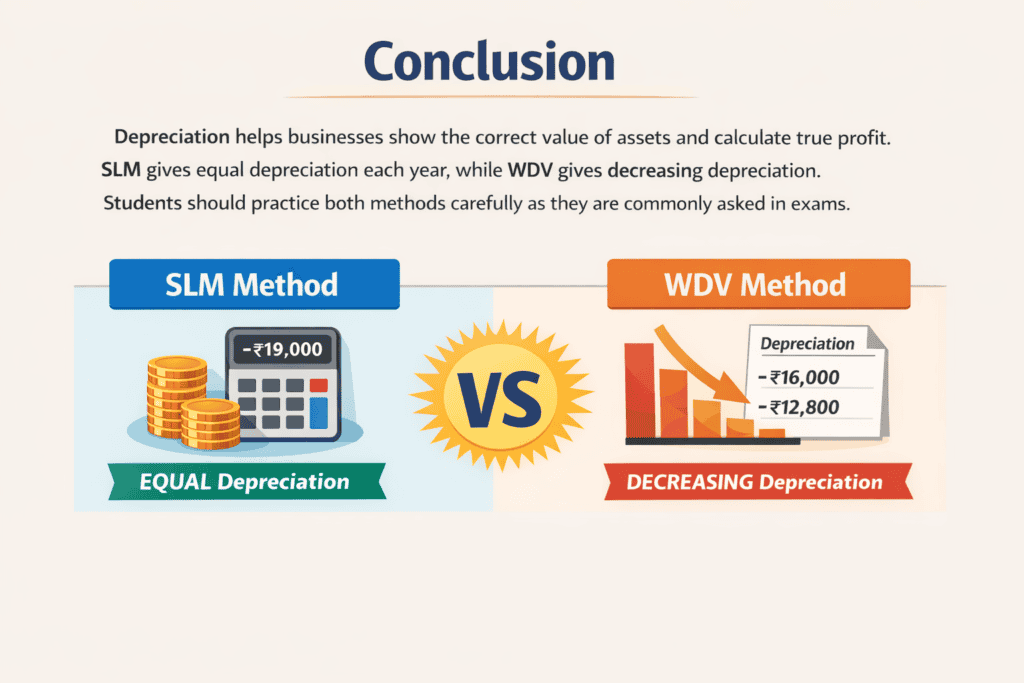
Same every year (FIXED)
Reduces every year (DECREASING)
Calculated On
Original Cost of Asset
Book Value (reducing balance each year)
Book Value at End
Becomes exactly Scrap Value
Never becomes zero
Best Suited For
Furniture, patents, leases
Machinery, vehicles, computers
Recognised by
Income Tax Act
Companies Act (Schedule II)
5. Method 1 — Straight Line Method (SLM)
SLM Formula: Annual Depreciation = (Cost of Asset − Scrap Value) ÷ Useful Life Rate of Depreciation = (Annual Depreciation ÷ Cost of Asset) × 100
Level 1 — SLM Basic (3-Year Ledger)
QUESTION A machine is purchased on 1st April 2021 for ₹1,00,000. Installation charges ₹5,000. Estimated scrap value ₹10,000. Useful life 5 years. Books closed on 31st March every year. Prepare Machinery Account for 3 years under SLM.
Working — SLM Calculation Cost of Machine = ₹1,00,000 + ₹5,000 (installation) = ₹1,05,000 Scrap Value = ₹10,000 Depreciable Cost = ₹1,05,000 − ₹10,000 = ₹95,000 Annual Dep (SLM) = ₹95,000 ÷ 5 years = ₹19,000 per year (FIXED every year)
Dr. Machinery Account Cr.
Dr.
Cr.
Date
Particulars
Amount (₹)
Date
Particulars
Amount (₹)
Year 2021-22
Year 2021-22
Apr 1
Bank A/c
1,05,000
Mar 31
Depreciation A/c
19,000
Year 2022-23
Mar 31
Balance c/d
86,000
Apr 1
Balance b/d
86,000
Year 2022-23
Year 2023-24
Mar 31
Depreciation A/c
19,000
Apr 1
Balance b/d
67,000
Mar 31
Balance c/d
67,000
Year 2023-24
Mar 31
Depreciation A/c
19,000
Mar 31
Balance c/d
48,000
✅ Note: Depreciation is ₹19,000 every year — FIXED under SLM. Book Value reduces by equal amount each year.
6. Method 2 — Written Down Value Method (WDV)
WDV Formula: Annual Depreciation = Book Value at Beginning of Year × Rate ÷ 100 (Note: Book Value reduces every year, so Depreciation also reduces!)
Level 2 — WDV Basic (3-Year Ledger)
QUESTION A machine purchased on 1st April 2021 for ₹1,00,000. Depreciation charged at 20% p.a. under WDV method. Books closed 31st March. Prepare Machinery Account for 3 years.
Working — WDV Year-wise Calculation Year 1: ₹1,00,000 × 20% = ₹20,000 → Book Value = ₹80,000 Year 2: ₹80,000 × 20% = ₹16,000 → Book Value = ₹64,000 Year 3: ₹64,000 × 20% = ₹12,800 → Book Value = ₹51,200
Dr. Machinery Account Cr.
Dr.
Cr.
Date
Particulars
Amount (₹)
Date
Particulars
Amount (₹)
Year 2021-22
Year 2021-22
Apr 1
Bank A/c
1,00,000
Mar 31
Depreciation A/c
20,000
Year 2022-23
Mar 31
Balance c/d
80,000
Apr 1
Balance b/d
80,000
Year 2022-23
Year 2023-24
Mar 31
Depreciation A/c
16,000
Apr 1
Balance b/d
64,000
Mar 31
Balance c/d
64,000
Year 2023-24
Mar 31
Depreciation A/c
12,800
Mar 31
Balance c/d
51,200
✅ Note: Depreciation DECREASES every year under WDV → ₹20,000 → ₹16,000 → ₹12,800. This is the key difference from SLM!
QUESTION Machinery purchased on 1st July 2021 for ₹60,000. Depreciation @ 10% p.a. SLM. Books closed 31st March every year. Prepare Machinery Account for 2 years.
Working — Proportionate Months Year 1 (Jul 2021 → Mar 2022) = 9 months only Dep = ₹60,000 × 10% × 9/12 = ₹4,500 Year 2 (Apr 2022 → Mar 2023) = 12 months (full year) Dep = ₹60,000 × 10% = ₹6,000
Dr. Machinery Account Cr.
Dr.
Cr.
Date
Particulars
Amount (₹)
Date
Particulars
Amount (₹)
Year 2021-22
Year 2021-22 (9 months)
Jul 1
Bank A/c
60,000
Mar 31
Depreciation A/c (9 months)
4,500
Year 2022-23
Mar 31
Balance c/d
55,500
Apr 1
Balance b/d
55,500
Year 2022-23 (12 months)
Mar 31
Depreciation A/c (12 months)
6,000
Mar 31
Balance c/d
49,500
8. Level 4 — Addition of Asset During the Year
QUESTION On 1st April 2021, machinery purchased for ₹80,000. On 1st October 2021, additional machinery purchased for ₹40,000. Depreciation @ 10% p.a. SLM. Books closed 31st March. Prepare account for 2 years.
Working — Year-wise Depreciation Year 1 (2021-22): Old Machine = ₹80,000 × 10% × 12/12 = ₹8,000 New Machine = ₹40,000 × 10% × 6/12 = ₹2,000 (Oct to Mar = 6 months) Total Year 1 Depreciation = ₹10,000 Year 2 (2022-23): Old Machine = ₹80,000 × 10% = ₹8,000 New Machine = ₹40,000 × 10% = ₹4,000 Total Year 2 Depreciation = ₹12,000
Dr. Machinery Account Cr.
Dr.
Cr.
Date
Particulars
Amount (₹)
Date
Particulars
Amount (₹)
Year 2021-22
Year 2021-22
Apr 1
Bank A/c (Old Machine)
80,000
Mar 31
Depreciation A/c
10,000
Oct 1
Bank A/c (New Machine)
40,000
Mar 31
Balance c/d
1,10,000
Total
1,20,000
Total
1,20,000
Year 2022-23
Year 2022-23
Apr 1
Balance b/d
1,10,000
Mar 31
Depreciation A/c
12,000
Total
1,10,000
Mar 31
Balance c/d
98,000
Total
1,10,000
9. Level 5 — Sale of Asset (Profit or Loss on Sale)
Steps for Sale of Asset (Always follow this order): Step 1: Charge depreciation up to date of sale Step 2: Calculate Book Value on date of sale Step 3: Compare Sale Price vs Book Value Step 4: Difference = Profit (if SP > BV) or Loss (if SP < BV) Step 5: Transfer to Profit & Loss Account
QUESTION Machinery purchased on 1st April 2020 for ₹1,20,000. Depreciation @ 10% p.a. SLM. On 30th September 2022, machine sold for ₹85,000. Books closed 31st March. Show Machinery Account.
Working — Step by Step Annual Dep (SLM) = ₹1,20,000 × 10% = ₹12,000 Year 1 (2020-21): Dep = ₹12,000 → BV = ₹1,08,000 Year 2 (2021-22): Dep = ₹12,000 → BV = ₹96,000 Year 3 (Apr–Sep 2022 = 6 months): Dep = ₹12,000 × 6/12 = ₹6,000 Book Value on sale date = ₹96,000 − ₹6,000 = ₹90,000 Sale Price = ₹85,000 | Book Value = ₹90,000 LOSS ON SALE = ₹90,000 − ₹85,000 = ₹5,000
Dr. Machinery Account Cr.
Dr.
Cr.
Date
Particulars
Amount (₹)
Date
Particulars
Amount (₹)
Year 2020-21
Year 2020-21
Apr 1
Bank A/c
1,20,000
Mar 31
Depreciation A/c
12,000
Year 2021-22
Mar 31
Balance c/d
1,08,000
Apr 1
Balance b/d
1,08,000
Year 2021-22
Year 2022-23
Mar 31
Depreciation A/c
12,000
Apr 1
Balance b/d
96,000
Mar 31
Balance c/d
96,000
Year 2022-23 (Sold — 6 months)
Sep 30
Depreciation A/c (6 months)
6,000
Sep 30
Bank A/c (Sale Proceeds)
85,000
Sep 30
Loss on Sale (P&L A/c)
5,000
✅ Note: Loss on Sale = Book Value (₹90,000) − Sale Price (₹85,000) = ₹5,000. Transferred to Profit & Loss Account.
10. Level 6 — Change of Method: SLM to WDV (Retrospective)
⚠️ This is the HARDEST question type — 90% of students fail this! Master it here. Step 1: Find depreciation already charged under OLD method (total) Step 2: Find depreciation that SHOULD have been charged under NEW method Step 3: Difference = Short Charged or Excess Charged Step 4: Adjust in current year P&L Account Step 5: New book value = WDV book value going forward
QUESTION Machine purchased on 1st April 2020 for ₹2,00,000. Scrap value ₹20,000. Life 9 years. Depreciation charged under SLM for 3 years. From 1st April 2023, company decides to change to WDV @ 20% p.a. with retrospective effect. Show the adjustment entry and Machinery Account for year 2023-24.
Step 1 — SLM Already Charged (3 Years) Annual SLM = (₹2,00,000 − ₹20,000) ÷ 9 = ₹20,000 per year 3 Years SLM Depreciation = ₹20,000 × 3 = ₹60,000 Book Value as per SLM after 3 years = ₹2,00,000 − ₹60,000 = ₹1,40,000
Step 2 — WDV That SHOULD Have Been Charged (3 Years) Year 1: ₹2,00,000 × 20% = ₹40,000 → BV = ₹1,60,000 Year 2: ₹1,60,000 × 20% = ₹32,000 → BV = ₹1,28,000 Year 3: ₹1,28,000 × 20% = ₹25,600 → BV = ₹1,02,400 Total WDV for 3 years = ₹97,600
Step 3 & 4 — Difference and Adjustment WDV Depreciation (should have been) = ₹97,600 SLM Depreciation (already charged) = ₹60,000 Short Charged = ₹37,600 → Debit Profit & Loss A/c Adjustment Entry: Profit & Loss A/c Dr. ₹37,600 | To Machinery A/c ₹37,600 New Book Value from 1st April 2023 = ₹1,02,400 (WDV after 3 years) Year 4 Depreciation (WDV) = ₹1,02,400 × 20% = ₹20,480
Dr. Machinery Account (Year 2023-24) Cr.
Dr.
Cr.
Date
Particulars
Amount (₹)
Date
Particulars
Amount (₹)
Year 2023-24
Year 2023-24
Apr 1
Balance b/d (SLM BV)
1,40,000
Apr 1
P&L A/c (Adjustment)
37,600
Total
1,40,000
Mar 31
Depreciation A/c (WDV)
20,480
Mar 31
Balance c/d
81,920
Total
1,40,000
11. Level 7 — Find Rate of Depreciation (Reverse Calculation)
QUESTION A machine was purchased for ₹1,00,000 on 1st April 2020. After 3 years the book value is ₹51,200 under WDV method. Find the rate of depreciation.
Working — Reverse WDV Formula Under WDV after n years: BV = Cost × (1 − r/100)ⁿ 51,200 = 1,00,000 × (1 − r/100)³ (1 − r/100)³ = 51,200 ÷ 1,00,000 = 0.512 (1 − r/100) = Cube Root of 0.512 = 0.8 r/100 = 1 − 0.8 = 0.2 Rate = 0.2 × 100 = 20% p.a.
Verification — Confirm the Answer Year 1: ₹1,00,000 × 20% = ₹20,000 → BV = ₹80,000 Year 2: ₹80,000 × 20% = ₹16,000 → BV = ₹64,000 Year 3: ₹64,000 × 20% = ₹12,800 → BV = ₹51,200 ✅ CORRECT!
Swathika B is an MBA graduate in Finance & Business Analytics , the founder of The Commerce Lab. With a strong academic foundation in B.Com BFSI and hands-on experience in financial analysis, data analytics, and business studies, she created this platform to make Commerce and Accountancy simple, practical, and exam-ready for students across India.