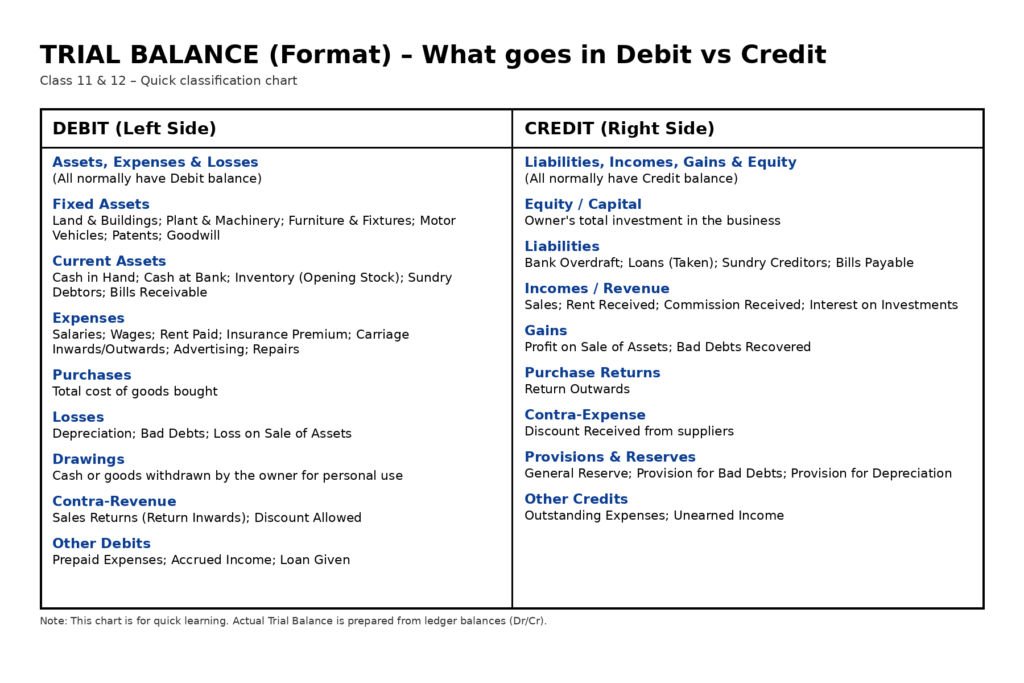
After recording all business transactions in the Journal and posting them into Ledger Accounts, the next step is preparing a Trial Balance.
A Trial Balance is a statement prepared on a particular date to check whether the total debit balances and total credit balances of all ledger accounts are equal.
If the total of the debit side is equal to the total of the credit side, the books are considered arithmetically correct.
Purpose of Trial Balance
To check the arithmetical accuracy of accounts
To summarize all ledger balances in one place
To help in preparing Final Accounts
To locate accounting mistakes
To prepare Trading Account, Profit and Loss Account and Balance Sheet
DEAD CLIC Rule
This is an easy memory trick to identify which accounts come under Debit and Credit.
Side
Letter
Meaning
Debit
D
Drawings
Debit
E
Expenses and Losses
Debit
A
Assets
Debit
D
Discount Allowed
Credit
C
Capital
Credit
L
Liabilities
Credit
I
Income and Gains
Credit
C
Creditors / Sales
Problem 1: Basic Fundamentals
Question Data
Account Name
Amount (₹)
Cash
50,000
Capital
2,00,000
Purchases
80,000
Sales
1,20,000
Salary
30,000
Rent
15,000
Debtors
75,000
Creditors
40,000
Furniture
1,10,000
Solution
S.No
Account Name
Debit (₹)
Credit (₹)
1
Cash
50,000
2
Purchases
80,000
3
Salary
30,000
4
Rent
15,000
5
Debtors
75,000
6
Furniture
1,10,000
7
Capital
2,00,000
8
Sales
1,20,000
9
Creditors
40,000
Total
3,60,000
3,60,000
Problem 2: Returns and Discounts
Question Data
Account Name
Amount (₹)
Opening Stock
25,000
Purchases
1,50,000
Sales
2,00,000
Returns Inward
10,000
Returns Outward
8,000
Wages
20,000
Discount Allowed
3,000
Capital
1,50,000
Building
67,000
Creditors
35,000
Bank Balance
60,000
Discount Received
2,000
Debtors
55,000
Carriage Inward
5,000
Solution
S.No
Account Name
Debit (₹)
Credit (₹)
1
Opening Stock
25,000
2
Purchases
1,50,000
3
Returns Inward
10,000
4
Wages
20,000
5
Discount Allowed
3,000
6
Building
67,000
7
Bank Balance
60,000
8
Debtors
55,000
9
Carriage Inward
5,000
10
Sales
2,00,000
11
Returns Outward
8,000
12
Discount Received
2,000
13
Capital
1,50,000
14
Creditors
35,000
Total
3,95,000
3,95,000
Problem 3: Closing Stock Adjustment
Note: Closing Stock = ₹30,000. Closing Stock does not appear in the Trial Balance.
Question Data
Account Name
Amount (₹)
Cash in Hand
15,000
Cash at Bank
45,000
Capital
3,00,000
Opening Stock
40,000
Drawings
20,000
Purchases
2,00,000
Sales
2,80,000
Expenses
85,000
Debtors
80,000
Creditors
55,000
Machinery
1,50,000
Solution
S.No
Account Name
Debit (₹)
Credit (₹)
1
Cash in Hand
15,000
2
Cash at Bank
45,000
3
Drawings
20,000
4
Opening Stock
40,000
5
Purchases
2,00,000
6
Expenses
85,000
7
Debtors
80,000
8
Machinery
1,50,000
9
Capital
3,00,000
10
Sales
2,80,000
11
Creditors
55,000
Total
6,35,000
6,35,000
Problem 4: High Capital Scenario
Question Data
Account Name
Amount (₹)
Capital
5,00,000
Cash
1,00,000
Bank
2,00,000
Purchases
1,50,000
Sales
2,00,000
Debtors
80,000
Salary
20,000
Rent
10,000
Creditors
60,000
Solution
S.No
Account Name
Debit (₹)
Credit (₹)
1
Cash
1,00,000
2
Bank
2,00,000
3
Debtors
80,000
4
Purchases
1,50,000
5
Salary
20,000
6
Rent
10,000
7
Capital
5,00,000
8
Sales
2,00,000
9
Creditors
60,000
Total
5,60,000
5,60,000
Problem 5: Manufacturing Business
Question Data
Account Name
Amount (₹)
Machinery
3,00,000
Capital
4,00,000
Purchases
1,20,000
Sales
1,80,000
Wages
40,000
Debtors
70,000
Creditors
50,000
Cash
1,00,000
Solution
S.No
Account Name
Debit (₹)
Credit (₹)
1
Machinery
3,00,000
2
Purchases
1,20,000
3
Wages
40,000
4
Debtors
70,000
5
Cash
1,00,000
6
Capital
4,00,000
7
Sales
1,80,000
8
Creditors
50,000
Total
6,30,000
6,30,000
Problem 6: Service Business
Question Data
Account Name
Amount (₹)
Professional Fees
90,000
Computer
45,000
Drawings
5,000
Cash
75,000
Office Rent
12,000
Electricity
3,000
Capital
50,000
Creditors
10,000
Prepaid Rent
10,000
Solution
S.No
Account Name
Debit (₹)
Credit (₹)
1
Computer
45,000
2
Cash
75,000
3
Prepaid Rent
10,000
4
Drawings
5,000
5
Office Rent
12,000
6
Electricity
3,000
7
Professional Fees
90,000
8
Capital
50,000
9
Creditors
10,000
Total
1,50,000
1,50,000
Problem 7: Small Business
Question Data
Account Name
Amount (₹)
Opening Stock
10,000
Purchases
35,000
Debtors
18,000
Stationery
2,000
Sales
60,000
Creditors
12,000
Capital
40,000
Furniture
47,000
Solution
S.No
Account Name
Debit (₹)
Credit (₹)
1
Opening Stock
10,000
2
Purchases
35,000
3
Debtors
18,000
4
Stationery
2,000
5
Furniture
47,000
6
Sales
60,000
7
Creditors
12,000
8
Capital
40,000
Total
1,12,000
1,12,000
Problem 8: Reserves and Provisions
Question Data
Account Name
Amount (₹)
Machinery
2,00,000
Capital
2,50,000
Debtors
1,00,000
Purchases
2,20,000
Sales
3,00,000
Bad Debts
5,000
Provision for Bad Debts
2,000
Creditors
70,000
Bank Overdraft
3,000
Solution
S.No
Account Name
Debit (₹)
Credit (₹)
1
Machinery
2,00,000
2
Debtors
1,00,000
3
Purchases
2,20,000
4
Bad Debts
5,000
5
Capital
2,50,000
6
Sales
3,00,000
7
Provision for Bad Debts
2,000
8
Creditors
70,000
9
Bank Overdraft
3,000
Total
5,25,000
5,25,000
Problem 9: Transport Business
Question Data
Account Name
Amount (₹)
Vehicles
8,00,000
Service Revenue
4,00,000
Capital
2,00,000
Cash at Bank
2,10,000
Fuel and Oil
50,000
Loan from Bank
5,00,000
Interest on Loan
40,000
Solution
S.No
Account Name
Debit (₹)
Credit (₹)
1
Vehicles
8,00,000
2
Fuel and Oil
50,000
3
Cash at Bank
2,10,000
4
Interest on Loan
40,000
5
Service Revenue
4,00,000
6
Loan from Bank
5,00,000
7
Capital
2,00,000
Total
11,00,000
11,00,000
Problem 10: General Store
Question Data
Account Name
Amount (₹)
Opening Stock
15,000
Purchases
60,000
Furniture
20,000
Debtors
25,000
Cash
33,000
Sales
95,000
Creditors
10,000
Capital
50,000
Carriage Outward
2,000
Solution
S.No
Account Name
Debit (₹)
Credit (₹)
1
Opening Stock
15,000
2
Purchases
60,000
3
Furniture
20,000
4
Debtors
25,000
5
Cash
33,000
6
Carriage Outward
2,000
7
Sales
95,000
8
Creditors
10,000
9
Capital
50,000
Total
1,55,000
1,55,000
Important Rules to Remember
Assets always come on the Debit side.
Expenses and losses always come on the Debit side.
Capital always comes on the Credit side.
Liabilities always come on the Credit side.
Income and gains always come on the Credit side.
Drawings always come on the Debit side.
Closing stock usually does not appear in the Trial Balance.
Swathika B is an MBA graduate in Finance & Business Analytics , the founder of The Commerce Lab. With a strong academic foundation in B.Com BFSI and hands-on experience in financial analysis, data analytics, and business studies, she created this platform to make Commerce and Accountancy simple, practical, and exam-ready for students across India.